Best Battery Tender for Marine Battery: Top Picks for 12V Marine Use
Answer: For marine owners seeking reliable, maintenance-friendly charging, these five options deliver automatic float charging, multi-stage programs, and protection features ideal for boats, docks, and wet environments. The picks suit boaters who want hands-off battery care, anglers with seasonal vessels, and fleet operators needing robust, marine-grade chargers. Below you’ll find who each product is best for, with clear comparisons and practical buying considerations. A quick summary table is included to help you compare core features at a glance.
Product Summary Table
| Product | Best For | Key Benefit | Limitations |
|---|---|---|---|
| Battery Tender Plus 12V 1.25A | Owners needing versatile 12V maintenance for cars, motorcycles, and lawn equipment | Adaptive smart charging with a 4-step program | Not specialized for lithium-only systems |
| NOCO Genius GEN5X2 | Mariners with multiple batteries and mixed chemistries | Two independent banks, broad mode support | Higher upfront cost |
| NOCO Genius GEN5X1 | Single-bank marine charging for limited battery setups | Compact, powerful, flexible modes | One-bank design limits scalability |
| Battery Tender Junior 12V 750mA | Seasonal boats and small engines needing maintenance during storage | Fully automatic “SuperSmart” charging with long-term maintenance | Lower amperage means slower charging |
| 2 Bank Marine Charger 5X2 (FirstPower Pro) | Boats with dual batteries and 24/7 charging needs | Two independent banks with selectable modes | May be more complex for beginners |
Battery Tender Plus 12V 1.25 AMP Car & Motorcycle Battery Charger and Maintainer

The Battery Tender Plus is a versatile 12V maintainer suited to automotive, motorcycle, and lawn equipment use, with an adaptive smart charging system that adjusts to battery needs. Its 4-step charging program helps optimize battery health and extend life. This model includes a 12V, 1.25A charger, plus wired accessories and a long-term warranty package. Best for buyers who want a single, reliable maintainer capable of handling various vehicle types. A potential limitation is that it is not lithium-specific, so use with suitable chemistries only; ensure compatibility before use.
Why this is a strong pick for marine tender buyers
Its adaptability and robust protection features make it a dependable baseline for boats that store or dock nearby. The 1.25A output balances rate and heat, reducing the risk of overcharging in tight spaces like bilge areas or compact docks. If you already own a Battery Tender ecosystem, this unit integrates smoothly with existing accessories and maintenance routines.
Who should avoid this model
Choose another option if your boat relies on lithium batteries or you need dual-bank charging without upgrading to a higher-capacity model.
NOCO Genius GEN5X2: 2-Bank, 10A Onboard Battery Charger

The GEN5X2 is designed for marine use with two independent banks delivering up to 5A per bank (10A total). It supports 12V lead-acid, AGM, and lithium chemistries, with selectable modes for each bank and a dedicated repair mode. It is notably compact and rugged for harsh marine environments. Best for boaters with multiple batteries or systems requiring separate maintenance cycles. A potential drawback is its higher price and installation considerations for permanent mounting.
Why it stands out for boats
Independent banks enable simultaneous charging of different battery types or banks across starting and deep-cycle systems. This flexibility reduces downtime and ensures critical systems stay ready for use, even if one bank is in a different state of charge.
Limitations to consider
With two banks, wiring complexity increases during installation. Verify space and access to both banks before selecting this model for small or tight compartments.
NOCO Genius GEN5X1: 1-Bank, 5A Onboard Battery Charger
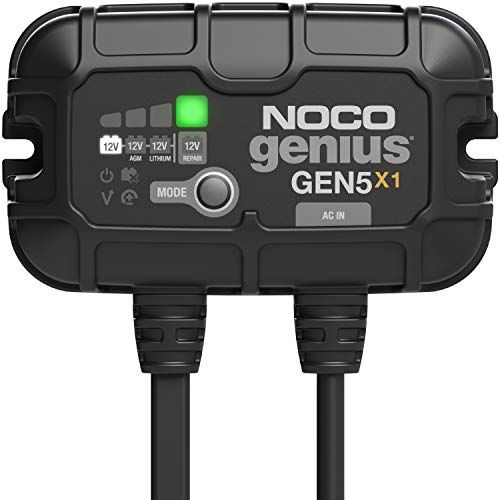
The GEN5X1 provides a compact, single-bank battery charging solution with 5A capacity. It shares GEN5X2’s versatile charging modes suitable for lead-acid, AGM, and lithium batteries, and includes temperature compensation features to adapt to environment changes. Best for boats with a single critical battery set or where space constraints require a smaller form factor. Limitations include less scalability for additional batteries compared to the two-bank variant.
Why pick GEN5X1 for marine use
Its rugged design and marine-grade build, combined with accurate mode options, help maintain engine-start batteries and auxiliary power without overcharging. The compact size makes it easier to install in tight bilge or console areas.
Important caveat
Ensure you have adequate space for panel wiring and mounting. It’s ideal for dedicated battery strings rather than mixed installs requiring multiple banks.
Battery Tender Junior 12V 750mA Charger and Maintainer

The Battery Tender Junior is a compact, fully automatic 12V maintainer with 750mA output. It supports a 4-step charging program to optimize 12V lead-acid, flooded, AGM, and gel batteries during long-term storage. Includes: 12V charger, a 12-foot output cord, a fused-ring terminal harness, and standard warranty coverage. Best for seasonal boats, small watercraft, and limited-space setups where a lighter charger is sufficient. Limitation: slower charging rates may not suit larger batteries or rapid replenishment needs.
Who benefits most
Owners who store their vessel for extended periods or need a simple, reliable maintainer will appreciate the high level of protection and automatic transition to float mode. It’s a practical starter option for basic dockside maintenance.
Potential downside
With a lower amperage, charging times are longer, especially for larger lead-acid or AGM packs. Ensure the unit meets your battery capacity and usage patterns.
Buying Guide: Key Considerations For Marine Battery Tenders
What battery chemistry will you charge?
Marine systems may use lead-acid, AGM, gel, or lithium batteries. Choose chargers that explicitly support your chemistry, and use correct settings to maximize longevity and safety.
Single-bank vs. multi-bank chargers
Single-bank models are compact and affordable but limit simultaneous maintenance of multiple batteries. Multi-bank chargers simplify complex boat electrical setups, letting you manage separate batteries or systems without swapping cables.
Amperage and charging rate
Higher amps charge faster but generate more heat. For boats with large deep-cycle batteries, higher-capacity units reduce downtime. For small 12V batteries, 750mA–1.25A units can be sufficient for long-term storage care.
Environmental robustness
Marine environments demand water resistance, moisture protection, and corrosion resistance. Look for IP ratings, sealed housings, and temperature compensation features to handle variable climates and dockside exposure.
Programmable charging steps
4-step or multi-stage charging programs help prevent overcharging and extend battery life. Programs typically include initialization, bulk charging, absorption, and float stages. A repair mode can help revive fatigued batteries in some models.
Ease of installation and compatibility
Check mounting options, cable lengths, and included connectors. Ensure compatibility with your boat’s existing electrical system and any safety certifications required for marine use.
FAQ
- What is a battery tender for marine use? A battery tender is a automatic charger-maintainer designed to keep marine 12V batteries at an optimal state of charge, often with multi-stage charging and safety protections. It helps prevent discharge during storage and supports long-term battery health.
- Do I need a dual-bank charger for a boat? If your boat uses separate starting and deep-cycle batteries or you want to independently manage each bank, a dual-bank charger is advantageous. It enables simultaneous, independent charging without cross-interference.
- Can I use these chargers with lithium batteries? Some models explicitly support lithium chemistry. Verify compatibility and set the correct mode for lithium batteries to avoid damage. Not all 12V maintainer models are suitable for lithium.
- Will these chargers harm my battery in storage? Properly programmed full-off maintenance modes reduce risk of overcharging during storage. Choose a charger with a float mode and protections such as spark-proofing and reverse polarity protection.
- What amperage should I choose for a marine battery? Larger deep-cycle or starter batteries benefit from higher amperage within safe limits; smaller 12V batteries may be adequately maintained with 750mA–1.25A units. Match your battery capacity and boat usage.
- Are there installation considerations for boats? Yes. Consider space, ventilation, access to outlets or shore power, corrosion resistance of connectors, and secure mounting, especially in damp or saltwater environments.