Best Bilge Pumps for Boats: Dependable 1100–750 GPH Options
Answering the need for reliable bilge water removal, this article highlights five practical boat bilge pumps that span automatic and manual operation, compact footprints, and varied flow rates. Ideal for boaters seeking safer, drier bilges, these picks cater to anglers, day cruisers, and small yachts alike. Each option is evaluated for who it fits best, common limitations, and why it stands out in typical marine environments.
| Product | Flow (GPH) | Best For |
|---|---|---|
| SEAFLO 06 Series Automatic Submersible Bilge Pump | 750 | Smaller craft, tight bilge spaces, automatic protection |
| Sanuke 1100GPH Bilge Pump | 1100 | Higher water load, quiet operation, non-automatic setup |
| Subtoy 1100GPH Automatic Kit | 1100 | Turnkey installation, auto operation, includes hoses and fittings |
| MAXZONE 1100GPH Automatic Submersible | 1100 | High flow with integrated float switch, compact design |
| Shoreline Marine 800GPH Submersible | 800 | Budget-friendly, quick install, basic automatic control |
SEAFLO 06 Series Automatic Submersible Bilge Pump

The SEAFLO 06 Series provides automatic bilge protection with a 750 GPH flow and a 3/4″ outlet. It includes a built-in float switch, an efficient 5-blade impeller, and a compact form factor suited for tight engine rooms and smaller vessels. Best for boaters who want hands-off bilge management in mid-sized to small boats or day cruisers. A potential limitation is that lower flow may be less effective in larger bilges or rapid water influx scenarios, where a higher-capacity pump could be preferred.
Sanuke 1100GPH Bilge Pump

The Sanuke pump delivers 1100 GPH with a 1-1/8″ outlet and is designed for harsh marine environments. It is non-automatic, prioritizing a straightforward, manual control approach and anti-airlock protection for reliable water evacuation. This model appeals to boaters who prefer direct power on/off control and robust performance, particularly when automatic sensing is not desired. It’s less ideal for unattended boats unless paired with a separate relay or switch system.
Subtoy 1100GPH Automatic Bilge Pump Kit
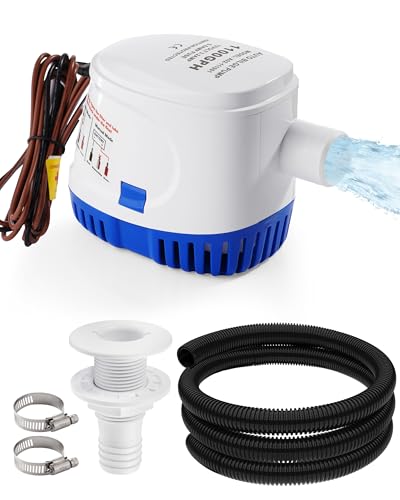
The Subtoy kit includes a built-in float switch and 1100 GPH capacity, plus hoses and fittings that simplify installation. It is best for boat owners who want an integrated solution with ready-to-use hardware. A caution is that the included fittings should be checked for compatibility with existing bilge plumbing in non-standard hulls, and the overall kit price may be higher than a bare-pump option.
FILTERUP 1100 GPH Automatic Bilge Pump

The FILTERUP model offers 1100 GPH with automatic operation via an integrated reed sensor. It includes a standard 1-1/8″ outlet and a compact footprint. This option is well-suited for mid-size boats needing dependable automatic containment without adding complex circuitry. Choose this if you want a straightforward, auto-controlled bilge solution with proven tabletop-style controls integrated into the pump body. A limitation is that some installations may require compatible mounting hardware for non-standard bilge layouts.
MAXZONE Automatic Submersible Bilge Pump

The MAXZONE unit provides 1100 GPH with a built-in float switch, 1-1/8″ outlet, and a compact 81 mm width. It is best for boaters who want reliable automatic operation with minimal installation complexity. A minor caveat is that customers should confirm the float switch responds consistently across varying water levels in larger or uniquely shaped bilges.
Shoreline Marine Submersible Bilge Pump

Shoreline Marine offers an 800 GPH fully submersible pump with a self-contained automatic switch. This option is a solid budget-friendly choice that’s easy to install on smaller boats or as a spare bilge pump. The trade-off is the lower flow compared to higher-capacity models, which may be insufficient for boats with larger bilges or heavy water ingress in rough conditions.
Buying Guide: Key Considerations When Choosing a Boat Bilge Pump
- Flow rate needs: Match GPH to your boat size and typical bilge volume. Higher GPH handles larger or faster-filling bilges but may consume more power.
- Automatic vs. manual: Automatic pumps simplify unattended operation, while manual units offer direct control for specific tasks or emergency use.
- Outlet size and fittings: Ensure 1-1/8″ or 3/4″ outlets align with your hoses and through-hull fittings to avoid leaks or compatibility issues.
- Power and draw: Most 12V pumps draw between 3–6A. Consider your battery capacity and alternator output for extended use.
- Installation space: Look for compact dimensions and accessible mounting points, especially on smaller vessels.
- Durability and materials: Submersible pumps should resist corrosion in saltwater environments; ensure gaskets and housings suit your operating conditions.
- Warranty and support: A longer warranty can indicate durability and manufacturer confidence in the product’s performance.
Frequently Asked Questions
- What is a typical bilge pump flow rate for a small boat? – Small boats often use 800–1100 GPH pumps; larger vessels may need 1500 GPH or more for rapid water removal.
- Do I need a separate float switch or a built-in one? – Built-in float switches simplify wiring and installation; separate switches offer flexible placement and control options.
- Can I use a marine bilge pump for freshwater ponds or pools? – Bilge pumps are designed for boats; using them in other settings may require different fittings and considerations.
- What maintenance is required for automatic bilge pumps? – Regular inspection of the impeller, seals, and electrical connections helps ensure reliable operation; test automatic function periodically.
- Are there safety considerations for automatic bilge pumps? – Ensure wiring is protected from moisture and that the pump has proper isolation and fuse protection to prevent shorts.
- Is a higher GPH pump always better? – Not always; higher flow may lead to overloading electrical systems or unnecessary power consumption in small bilges.