Best Bottom Coat Boat Paint Options for 2026
Choosing the right bottom paint depends on hull material, water conditions, and how you use your boat. This guide highlights five top options to help you pick the best antifouling coating for fiberglass, wood, and steel hulls. Ideal buyers include frequent sailors, anglers, and commercial boaters who need durable antifouling protection with manageable maintenance. Below is a quick summary of the selected products to compare key aspects and suitability at a glance.
| Product | Best For | Key Benefit | Coating Type |
|---|---|---|---|
| TotalBoat Underdog Black | Frequent boaters in saltwater | Single-season protection with copper biocide | Ablative |
| Rust-Oleum Marine Flat Black | Fiberglass, wood, steel underbodies | Slow copper release for fouling prevention | Traditional antifouling |
| TotalBoat Underdog Blue | Active boaters in mixed waters | Same economical protection as black variant | Ablative |
| TotalBoat JD Select Ablative Black | Sail and power boats seeking easy maintenance | Self-polishing, reduces next-season sanding | Ablative |
| Interlux Bottomkote NT Blue | Marina-restricted areas, low-odor needs | Best-in-class antifouling in a low-odor formula | Antifouling |
TotalBoat Underdog Marine Antifouling Bottom Paint – Black
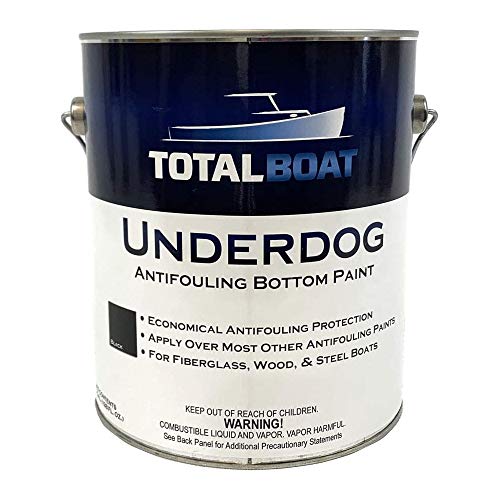
Best for boats that see frequent usage in saltwater, this economical antifouling coating provides strong single-season protection. Copper biocide helps prevent barnacles and mussels from clinging to hulls in varied conditions, while the durable finish resists trailering and beaching better than traditional ablatives.
Best for: sailboats, power boats, fishing craft, and work boats in saltwater environments where a cost-effective, reliable antifouling solution is needed.
Limitation: Because this is an ablative coating, buildup is minimized during the season but will wear away with use, requiring a reapplication plan for next season.
Rust-Oleum Marine Flat Boat Bottom Antifouling Paint – Black

Ideal for fiberglass, wood, or steel surfaces to prevent fouling below the waterline. This coating is formulated to slowly release copper, helping prevent barnacle and weed growth. It re-coats within 4 hours and is ready to launch in about 16 hours, covering up to 110 sq ft.
Best for: boaters who want a straightforward, quick-recoat option with a moderate coverage area and a simple maintenance profile.
Caution: Performance depends on proper surface prep and environmental conditions; avoid excessive buildup by following recoat intervals and sanding as needed between seasons.
TotalBoat Underdog Marine Antifouling Bottom Paint – Blue

This blue variant shares the same economical, single-season antifouling approach as the black version. It releases fresh biocide as water flows under the boat, helping prevent barnacles and mussels in saltwater and brackish environments. It’s designed for boats used frequently, with a durable finish for trailering and beaching.
Best for: boats that routinely operate in saltwater or brackish water and need a visually distinct option to help identify treated hulls.
Limitation: Color choice does not impact performance; the selection mainly affects visibility and personal preference.
TotalBoat JD Select Ablative Black – Quart

Antifouling paint for boats using a self-polishing, ablative film that wears away slowly as the boat moves. Suitable for fiberglass, wood, and steel boats in both salt and fresh water. Low odor and low VOCs make cleanup easy with soap and water, and it’s formulated to reduce bottom paint buildup for easier next-season maintenance.
Best for: sailors and powerboat owners who want a low-toxicity, easy-cleanup option with reduced future prep work.
Limitation: Lower odor and VOC reductions come with a trade-off in long-term wear depending on water exposure and marina conditions.
TotalBoat JD Select Ablative Black – Gallon

This ablative antifouling option shares the same self-polishing characteristics as the quart version, offering extended protection with a slightly larger container for longer season needs. The formulation minimizes paint buildup and can be burnished for a smoother, faster finish. It maintains low odor and easy cleanup, suitable for marinas with environmental restrictions.
Best for: longer seasons or larger boats that require fewer repaint cycles and easy reapplication between uses.
Limitation: May require more frequent light sanding or burnishing to maintain a perfectly clean surface for best performance over the season.
Interlux Fiberglass Bottomkote NT – Blue

Best-in-class antifouling for boats with fiberglass hulls, designed for low odor and user-friendly application. This product is positioned to meet marina environmental standards while providing effective antifouling performance. The blue color helps distinguish treated areas on the hull.
Best for: boaters who need a high standard of antifouling with reduced environmental impact and easier cleanup, especially in restricted marina areas.
Caution: As with all copper-based coatings, proper surface prep and environmental compliance are essential to achieve optimal results.
Buying Guide
What should I consider when choosing bottom paint?
Hull material, water type (salt, brackish, fresh), and usage frequency determine the best coating. Ablative paints wear away with movement, reducing buildup but requiring reapplication. Non-ablatives stay longer but may need more effort to remove when repainting.
Do I want ablative or conventional antifouling?
Choose ablative (self-polishing) for high-usage boats to minimize paint buildup and simplify next-season prep. Conventional coatings tend to last longer but can require more aggressive removal when repainting.
Is odor and environmental impact important?
Low-VOC and low-odor options are preferred in marinas with restrictions. Many low-VOC formulas are water-based, offering easier cleanup and reduced fumes during application.
What about color and visibility?
Color choices mainly affect visibility and identification of treated hull areas. Performance remains similar across color options within a given product line.
How do I apply and maintain antifouling paint?
Follow surface preparation guidelines: clean, sand lightly, and remove any old coatings that may interfere with adhesion. Apply according to manufacturer instructions, maintain a consistent coat thickness, and reapply on a season basis or as needed by usage and water conditions.
FAQ
- What is the typical lifespan of an antifouling bottom paint? Most ablative formulas provide protection for a single season to a season-and-a-half, depending on usage and water conditions.
- Can I use bottom paint on aluminum hulls? Some products are suitable for aluminum or require a barrier coat; check manufacturer guidelines for compatibility.
- Do I need to remove old paint before applying new? It depends on the product and current coating; many require proper scuffing or sanding to ensure adhesion.
- Are low-VOC options as effective as traditional formulas? Yes, many low-VOC coatings offer comparable antifouling performance with easier cleanup and better environmental compliance.
- How soon can I launch after applying bottom paint? Recoat and launch times vary; follow the product’s specified cure and recoat times for best results.
- Which option is best for marina restrictions? Look for low-odor, low-VOC, and water-based formulas such as Interlux Bottomkote NT or other specified marina-friendly products.