Best Marine Alternator Battery Charger Solutions for Boats and RVs
When selecting a marine alternator battery charger, the goal is to reliably charge and maintain multiple battery types while protecting your electrical system. This guide highlights five 12V to 24V capable chargers that satisfy common boating and RV needs. Best for dual-battery setups, the options cover lead-acid, AGM, Gel, and LiFePO4 chemistries, with waterproofing and smart charging features. Each product section notes who it’s best for and why it was chosen. The buying table below helps you compare at a glance.
| Product | Type | Best For | Key Benefit |
|---|---|---|---|
| FirstPower Pro 2 Bank 5X2 | 2-bank 10A total | Boat owners needing independent bank modes | Independent mode per bank; IP68 waterproof |
| Victron Orion-XS Smart DC-DC | DC-DC charger | Dual-battery systems from alternators | High efficiency, configurable, IP65 |
| NOCO GEN5X2 | 2-bank 10A total | Harsh marine environments | Compact, powerful with multiple modes |
| NEXPEAK NC201 | 10A smart charger | Everyday maintenance and quick charging | Smart trickle and repair features |
| RENOGY REGO DC-DC | DC-DC with MPPT | Solar-assisted charging | MPPT prioritizes solar energy |
FirstPower Pro 2 Bank 5X2 Marine Battery Charger

Best for boat owners who need independent charging for two 12V batteries. The charger supports 12V SLA/AGM, 12V Lithium (LiFePO4), and 12V Calcium chemistry. Each bank runs at 5A with IP68 waterproof protection for onboard use. It includes a Force Mode to revive deeply discharged batteries below 1V by holding the MODE button for 5 seconds. This model suits users who require continuous charging aboard in all weather, with 24/7 maintenance capability.
Who it’s best for: anglers and skippers with two battery banks that need separate charging profiles and robust waterproofing. Why chosen: independent bank control and 24/7 onboard charging make it flexible for varied battery chemistries.
Caution: ensure battery voltages are monitored when using Force Mode, as improper use could stress heavily discharged cells. The data notes manual activation for dead batteries but real-world results depend on battery health.
Victron Orion-XS Smart DC to DC Charger

The Orion-XS is designed for dual-battery systems charged by intelligent alternators. It emphasizes safety and efficiency with 98.5% efficiency and a 700W continuous output, even at high ambient temperatures. It offers configurable input/output currents to match various alternators and batteries, protecting the system from overload while ensuring the auxiliary battery stays properly charged.
Who it’s best for: sailors and campers with sophisticated dual-battery setups that require precise, configurable charging. Why chosen: high efficiency and IP65-rated water resistance make it well-suited for harsh marine environments.
Caution: configuration requires attention to alternator capability to avoid overload; ensure compatible wiring and fusing are in place for safety.
NOCO GEN5X2: 2-Bank 10A Onboard Charger
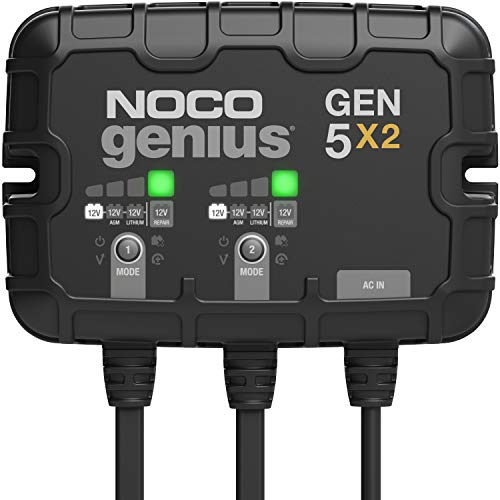
This 2-bank charger delivers 5A per bank and offers multiple charging modes per bank, including 12V, 12V AGM, 12V Lithium, and a Repair Mode. It is designed to be compact yet powerful, and it is engineered for use in demanding marine environments. It operates with smart temperature compensation to prevent overcharging in heat and undercharging in cold conditions.
Who it’s best for: boat owners who want compact, modern charging with independent banks and Lithium support. Why chosen: high efficiency and a robust charging mode selection per bank make it flexible for mixed battery chemistries.
Caution: although compact, ensure the unit has proper mounting and ventilation to avoid heat buildup in enclosed spaces.
NOCO GENIUS1: 1A Smart Charger & Maintainer

The GENIUS1 is a compact solution for 6V and 12V lead-acid and LiFePO4 batteries. It provides battery maintenance, trickle charging, and a desulfator with temperature compensation. It’s suitable for small boats or auxiliary batteries used for trolling motors where space and weight matter.
Who it’s best for: owners needing a simple, low-current maintainer with desulfation capability. Why chosen: small footprint and versatile chemistry support make it a good secondary charger or maintainer.
Caution: as a single-bank charger, it is not ideal for large multi-battery systems requiring independent charging profiles.
STANLEY BC25BS Smart 12V Battery Charger

STANLEY’s BC25BS offers 75-amp engine start support and maintains AGM, GEL, or WET 12V batteries. It features high-frequency smart charging and auto-switching between fast charge, top-off, and trickle to keep batteries ready for use. Its focus is emergency starting and general maintenance in marine settings.
Who it’s best for: boat owners who also need an emergency start boost or quick top-up in marina environments. Why chosen: strong start assist and adaptive charging help in critical situations.
Caution: the unit emphasizes starting power; for routine battery maintenance, consider a separate dedicated charger to reduce wear on starting circuits.
NEXPEAK NC201 10-Amp Smart Charger

The NC201 is a 10A smart charger with 7-stage charging, including trickle and desulfation, designed for 12V and 24V lead-acid and LiFePO4 batteries. It includes temperature compensation and protections for reverse polarity, overcurrent, and short circuits. It can service cars, boats, lawn equipment, and marine batteries during storage.
Who it’s best for: users seeking a versatile, feature-rich charger with robust protections. Why chosen: the 7-stage charging and temperature compensation support reliable battery health across seasons.
Caution: note that charging current should be matched to battery size to prevent overcharge or heat buildup; avoid exceeding 15A with smaller batteries.
Buying Guide
Key considerations help you pick the right marine alternator battery charger for your setup:
- Battery chemistry support: Confirm compatibility with lead-acid, AGM, GEL, and LiFePO4 to future-proof the charger.
- Bank configuration: Two-bank or multi-bank chargers simplify managing separate battery systems (starting vs house batteries).
- Waterproofing and enclosure rating: For exposed locations, IP68 or IP65 ratings indicate better moisture resistance.
- Charging modes and programmability: Independent bank modes, lithium and calcium settings, and repair modes help tailor charging to your batteries.
- Energy source and integration: DC-DC chargers are ideal with alternators; MPPT-enabled units optimize solar-assisted charging.
- Safety features: Look for temperature compensation, auto-restart, reverse polarity protection, and overcurrent safeguards.
Comparison tips: use per-bank amperage as a guide to match load with battery size. If you have two different battery chemistries, prioritize a charger with separate mode control per bank. For solar-equipped vessels, a DC-DC charger with MPPT can maximize energy capture from solar panels and alternators.
FAQ
- What is the difference between a DC-DC charger and an onboard AC charger? — A DC-DC charger connects to the vessel’s alternator or solar, delivering charging directly to service batteries, often with MPPT. An onboard AC charger plugs into shore power and charges batteries via AC-to-DC conversion.
- Can I charge LiFePO4 and lead-acid batteries with the same charger? — Many modern chargers support multiple chemistries, but check compatibility for each bank and battery type.
- Is waterproofing essential for boat chargers? — For exposed or wet environments, IP68 or IP65 ratings reduce risk from splashes and salt spray.
- Do I need a separate charger for each battery bank? — If you have distinct energy needs or chemistries, a multi-bank charger with independent modes is advantageous.
- What does “temperature compensation” do? — It adjusts charging voltage based on ambient temperature to prevent overcharging in heat and undercharging in cold.
- What should I avoid when selecting a charger? — Avoid charging batteries far below their recommended voltage; use a charger that matches your battery capacity and chemistry to prevent damage.