Best Boat Motor Compression Test Tools for Marine Engines
Answering the need for quick, accurate cylinder pressure readings on boats and small marine motors, these compression testers help diagnose issues like worn rings, leaky valves, or fuel delivery problems. They’re best for boat owners, marine technicians, and DIYers who service outboard motors, stern drives, and other small marine engines. Below is a curated set of tools that balance compatibility, ease of use, and durability, with a quick buyer’s guide and FAQs to help you decide.
| Product | Why It’s a Fit | Best For |
|---|---|---|
| Clatoon 8pcs Petrol Engine Cylinder Compression Tester Kit | Rugged build, 0-300 psi gauge, universal adapters | Outboard motors and small gas engines needing quick, reliable readings |
| Marvelity 9pcs Petrol Engine Compression Tester Kit | 3″ gauge, built-in spark tester, multiple adapters | Identifying ignition and fuel-system issues on small engines |
| Orion Motor Tech 8pc Gasoline Compression Tester Kit | Triple-scale gauge, broad engine compatibility | Marine, car, and small engine testing with versatile connections |
| Fiada 9 Pieces Automotive Compression Tester Kit | Comprehensive kit with spark tester and ABS case | All-in-one diagnostic for boats, cars, and ATVs |
| Mityvac MV5530 Engine Compression Test Kit | Professional-grade, dry/wet testing, threaded adapters | Marine and small engines requiring precise peak readings |
Clatoon 8pcs Petrol Engine Cylinder Tester Kit

The Clatoon kit provides a robust, rust- and corrosion-resistant tester with a large acrylic dial and a 0-300 psi range, making it suitable for boat motors and other small gas engines. It features two universal rubber cone adapters for quick connections and an extended hose to reach tight spaces on marine engines. Best for boat owners who want a durable, plug‑and‑play solution that reduces fuel-injection risk with one-click pressure release. A limitation is that it emphasizes gasoline engines; verification is recommended for non-gas marine applications.
Who it’s best for: DIY boat owners, small-service shops, and scrutineers who value durability and quick setup. Why selected: comprehensive adapter options, straightforward operation, and a clear gauge readout support reliable marine diagnostics.
What to watch for: While robust, this kit may require occasional recalibration if used frequently in harsh marine environments. It’s not designed for diesel engines or very large displacement marine systems.
BETOOLL 9pcs Compression Tester with Spark Plug Tester
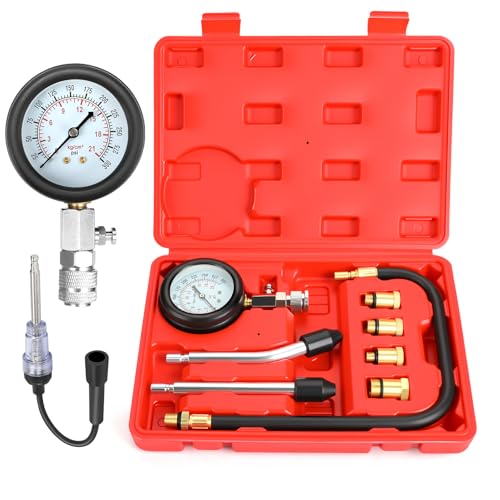
BETOOLL’s kit combines a 0-300 psi gauge with a spark plug tester for diagnosing ignition and fuel-delivery issues quickly. The set is designed for petrol engines in cars, motorcycles, and outboards, with an easy one-hand inflation/deflation design and quick-connect adapters. Best for users who want an all-in-one tool that quickly confirms spark problems alongside compression readings. Caution: Not suitable for diesel engines, so ensure your marine application is gasoline-based before purchasing.
Best for: Marine technicians and DIYers who want immediate ignition feedback alongside pressure data. Why chosen: integrated spark tester helps pinpoint ignition faults in addition to compression data, saving time during in-situ boat diagnostics.
Limitations: Not compatible with diesel engines; ensure your outboard is gasoline-powered to avoid misfit fittings.
Orion Motor Tech 8pc Gasoline Compression Tester Kit

Orion Motor Tech offers a comprehensive, all-in-one set with a 3-inch gauge that reads 0-300 psi and dual units. It includes four adapters, two connectors, and a flexible extension hose. Best for boaters who need a broad compatibility range (cars, trucks, motorcycles, snowmobiles) and a durable, easy-to-read gauge. Choose this if you require precise, multi-unit readings and straightforward compatibility for limited storage space on board.
Best for: Mariners performing frequent compression checks across multiple engine types. Why selected: triple-unit gauge simplifies cross-engine comparisons; robust build suits marine environments. Caution: Some users may prefer a dedicated outboard-specific kit for extreme salt exposure.
Fiada 9 Pieces Automotive Compression Tester Kit
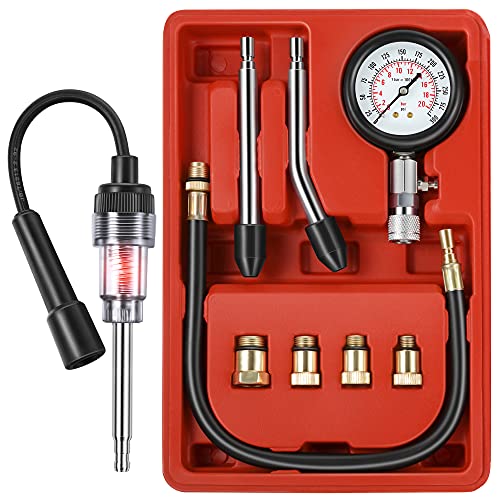
Fiada’s kit is an all-in-one package with 8 compression components plus a spark tester, designed for cars, motorcycles, ATVs, and boats. It includes straight and curved adapters, four brass adapters, and a 14-inch extension hose. Best for boat owners who want a single kit that covers ignition testing and comprehensive compression measurement, with an ABS storage case for organization. A caveat is that some adapters may not fit every obscure spark plug depth, so verify connector compatibility with your engine model.
Who it’s for: Those who value a complete diagnostic suite in a single purchase. Why chosen: built-in spark tester helps identify ignition-related failures alongside compression data; included extension hose reaches harder-to-access ports.
Limitation: Compatibility notes indicate broad coverage, but verify specific marine spark plug depths before purchase.
Mityvac MV5530 Engine Compression Test Kit

The Mityvac MV5530 is a professional-grade kit designed for dry and wet compression tests, with threaded adapters for motorcycles, marine engines, and small engines. It includes extensive accessories and extended hoses for hard-to-reach valves, plus a manual pressure release for accurate peak readings. Best for serious technicians who service boats and small marine engines regularly. A limitation is that it may be more complex and pricier than basic consumer kits, so targeted use is recommended.
Who it’s for: Marine technicians and serious DIYers who require precise, repeatable measurements and flexibility for valve seal checks. Why chosen: proven reliability and a range of threaded adapters support a wide variety of marine applications. Caution: More complex setup may require familiarity with dry/wet testing techniques.
Buying Guide: What to Look For When Choosing a Boat Motor Compression Tester
- Engine compatibility: Ensure the kit covers gasoline outboards, inboards, and other small marine engines you service.
- Gauge readability: Opt for a large dial with dual or triple units (psi, bar, kg/cm²) for quick, clear readings on a moving boat.
- Adapters and reach: Look for universal adapters and an extended hose to reach tight spaces under hoods or between cylinders.
- One-click release: A release valve simplifies deflation and reduces fuel system risk during testing.
- Durability: Marine environments demand rust- and corrosion-resistant components and protective coatings.
- Additional diagnostics: Spark plug testers or integrated check valves add value by diagnosing ignition or fuel delivery alongside compression.
- Storage and portability: A robust carrying case helps maintain kit integrity and keeps components organized on a boat.
Frequently Asked Questions
- What is a typical compression reading for a healthy boat engine?
- Can I use any compression tester on a boat motor?
- What’s the advantage of a spark plug tester in the kit?
- Should I perform dry or wet compression tests on a boat engine?
- How important are adapters and hose length?
Healthy gasoline marine engines generally show compression readings within the manufacturer’s specified range, typically around 120-180 psi per cylinder for small outboards, though this varies by model. Compare across cylinders for uniformity and check against the engine’s service manual.
Most gasoline marine engines will work with a standard compression tester that covers 0-300 psi or 0-20 bar. Diesel engines require different equipment, so verify engine type and required range before use.
A spark plug tester helps verify ignition is delivering a spark, which can pinpoint ignition faults that mimic low compression readings, speeding diagnosis.
Dry tests measure instantaneous cylinder pressure and gauge mechanical condition, while wet tests add a small amount of oil to the cylinder to check ring sealing. Both can provide valuable insights; follow kit instructions for the recommended procedure.
Adapters ensure secure connections to various spark plug depths, while longer hoses help reach cramped marine compartments. Poor connections or short hoses can lead to inaccurate readings or failed tests.