Best Boat Trailer Moving Devices for Easy Hauling and Positioning
Answering the need to move and position boat trailers with minimal effort, these five products stand out for different towing scenarios. The best choice depends on trailer weight, surface terrain, and whether you want a manual or electric mover. This guide helps you compare options for personal driveways, marinas, or storage lots. The top picks below cater to boat trailers, RVs, campers, and utility trailers with varying tongue weights and maneuverability.
Summary of selected products
- Heavy Duty Trailer Dolly (1200 lbs) — sturdy mid-range option for boat trailers and small RVs.
- Goodyear Electric Trailer Dolly — high-capacity electric mover ideal for frequent trailer handling.
- Trailer Tug — ultra-heavy duty, non-electric mover for large trailers and tight spaces.
- Trailer Mover Dolly (3500 lbs) — versatile, adjustable tongues for multiple trailer types.
- YOLANDO Trailer Dolly (600 lbs) — compact, solid-tire design suited for small to medium trailers.
Heavy Duty Trailer Dolly 1200 lbs Capacity

Best for: Boat trailers and mid-size RVs that require high tongue weight handling without electric power. This dolly uses carbon steel with a powder-coated finish to withstand outdoor use and heavy loads. The two 15.2-inch pneumatic tires provide good traction on grass, gravel, sand, and concrete, while an 8-inch universal swivel caster enables precise navigation in tight spaces. The 2-inch hitch ball is height-adjustable from 18 to 22 inches for compatibility with various trailers.
Why selected: It strikes a balance between strength and maneuverability for frequent, manual trailer repositioning. The elevated tongue weight capacity supports most personal boat trailers, making it a solid option for driveway and marina use.
Caution: Pneumatic tires require regular inspection for wear and proper air pressure to maintain smooth operation on uneven surfaces.
Goodyear Electric Trailer Dolly

Best for: Boat and RV owners who want effortless, motor-assisted movement. This electric dolly supports up to 7500 lbs gross trailer weight and 1100 lbs tongue weight, with all-terrain tires for various surfaces. The design includes a patented adjustable ball attachment and a collapsible frame for quick setup and maintenance-free operation.
Why selected: The electric drive reduces manual effort for heavy or long shifts, making it suitable for frequent trailer repositioning in marinas or large storage lots. The all-terrain wheels add stability on uneven grounds.
Limitation: While powerful, setup and storage require attention to the collapsed frame configuration to maximize space efficiency when not in use.
Trailer Tug — Up To 20,000 LBS Load
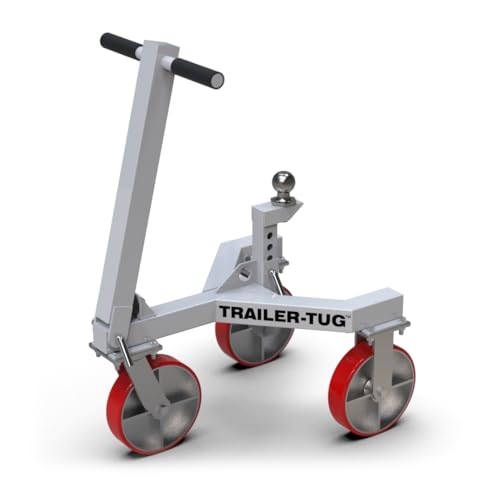
Best for: Large, commercial-grade trailer handling where high weight and precision in tight spaces are required. It’s a manual, non-electric mover designed to move heavy trailers—like oversized boat trailers and campers—without relying on power sources. The unit supports up to 20,000 lbs of trailer weight and 3,500 lbs of tongue weight, featuring a reinforced steel frame and wide base for stability.
Why selected: This option is ideal for garages, storage yards, or marinas where a powerful, non-electric solution is needed to reposition heavy trailers with controlled, hand-driven movement.
Limitation: It is a manual tool; users must apply more physical effort for very heavy loads or long distances.
Trailer Mover Dolly With 2″ And 2-5/16″ Tongues

Best for: Versatile towing needs with multiple hitch options. This dolly handles up to 3,500 lbs tongue weight and includes adjustable 2-inch and 2-5/16-inch couplers to fit different trailers. Its compact, weatherproof steel frame and rubber wheels enable reliable operation in diverse environments.
Why selected: The dual-coupler design makes it a flexible choice for owners who transfer between different trailers, including RVs and small boats. The compact form helps in tight garages or campsites.
Limitation: The unit’s weight capacity is suitable for many trailers but not for the heaviest boats or flatbeds, so verify your trailer’s tongue weight before purchasing.
YOLANDO Trailer Dolly 600 lbs

Best for: Small to medium trailers or light-duty boat trailers where compact, durable design and solid tires are valued. With a 600 lbs capacity, a 12-inch solid tire setup, and easy handling, this dolly is well-suited for driveway use and simple yard moves.
Why selected: A dependable, rust-resistant option for occasional moves that don’t require heavy lifting. It’s easier to maneuver in restricted spaces and stays reliable with minimal maintenance.
Caution: Solid tires do not offer the same shock absorption as pneumatic tires, which can affect comfort on rough surfaces.
Buying Guide: Key Considerations For Boat Trailer Movers
- Tongue Weight Capacity: Select a mover with a tongue weight rating that matches or exceeds your trailer’s tongue weight. Overloading can reduce stability and control.
- Load Capacity vs. User Needs: Electric movers excel for frequent heavy-lifting; manual movers work well for occasional repositioning and space-constrained areas.
- Tire Type And Terrain: Pneumatic tires provide cushion on soft surfaces but require maintenance; solid tires offer durability on hard surfaces but less shock absorption.
- Coupler Compatibility: Ensure the hitch ball size (2″ or 2-5/16″) matches your trailers. Some models offer adjustable tongues for multiple trailer types.
- Storage And Setup: Collapsible frames and lightweight designs improve storage efficiency in garages or campsites. Consider how easy it is to assemble and deploy the mover.
Frequently Asked Questions
- What is the difference between manual and electric boat trailer movers?
– Manual movers require physical effort to push or pull a trailer, while electric movers use a motor to reduce effort and speed up positioning. - How do I choose the right tongue weight capacity?
– Match the mover’s tongue weight rating to your trailer’s tongue weight, ensuring the mover can safely handle the load. - Are pneumatic tires better than solid tires for boat trailers?
– Pneumatic tires absorb shocks on uneven terrains; solid tires are more durable on hard surfaces and require no inflation. - Can I use a trailer dolly on grass and sand?
– Some models with larger pneumatic tires are designed for grass and sand; check the product’s terrain recommendations and load limits. - Do I need to disassemble a dolly for storage?
– Many models feature compact or collapsible frames; verify the model’s storage size and ease of reassembly in the manual.