Best Portable Boat Gas Tanks for Safer, More Efficient Marine Fueling
Answering the need for reliable, spill-resistant fuel storage on the water, this guide highlights top portable boat gas tanks that simplify refueling, extend run time, and resist harsh marine environments. Each pick is evaluated for durability, compatibility, and practicality, helping boaters choose the right tank for small inflatables, tied-to-dock vessels, or mid-size fishing boats. The following options emphasize portability, leak prevention, and ease of use in salt spray, humidity, and varying storage spaces. The brief buying table below helps you compare core specs at a glance.
| Product | Capacity | Best For |
|---|---|---|
| AloneGoer 3 Gallon | 3 gal (12 L) | Small boats, spare on-board fuel |
| Scepter 12 Gallon | 12 gal (45 L) | Longer runs, larger boats |
| Scepter 6 Gallon | 6 gal (22.7 L) | Mid-range capacity, under-seat storage |
| VEVOR 12 L | 3.17 gal (12 L) | Compact, versatile transfer tank |
| PeakPursuit 3 Gal | 3 gal | Under-seat or deck storage, easy handling |
AloneGoer 3 Gallon Portable Boat Fuel Tank
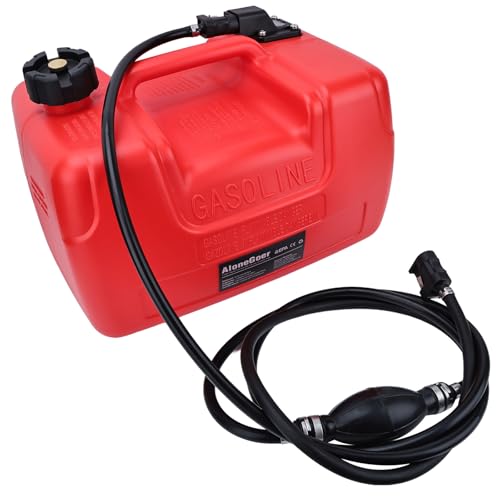
The AloneGoer 3 Gallon Tank is designed for small to mid-size boats and outboards, with a 12 L capacity and a marine-grade hose connector compatible with Yamaha 6YL-24201-24-00. It uses multi-layer HDPE-EVOH-HDPE barrier technology to minimize fuel permeation, with a claimed 98% reduction in evaporation compared to standard tanks. UV stabilization and a salt spray resistant formulation are emphasized to withstand high-humidity, salty environments. Best for: inflatables, small boats, or as a spare tank on board for quick refueling. Caution: ensure proper venting and check compatibility with your engine’s fuel line before use.
Why it’s selected: This tank prioritizes fuel retention and durability in tough marine conditions. It’s a compact option that pairs well with Yamaha outboards and is a solid choice for boaters who want a reliable spare or extra capacity without sacrificing space.
Scepter 12 Gallon Portable Marine Gas Can

The 12-gallon Scepter tank offers generous capacity in a compact profile, ideal for boats needing extended run times. It features a 2-way vented cap to regulate air flow and pressure, reducing vapor buildup during refueling. A built-in fuel gauge and pickup simplify level checks, while the container is EPA & CARB compliant for broader regulatory alignment. Best for: boaters seeking longer operation between fills on larger boats or when dock access is limited. Caution: a separate fuel line is required for full operation, and fitment should align with standard 1/4 NPT marine fittings.
Why it’s selected: It combines high capacity with practical refueling features, making it a strong choice for anyone who prioritizes extended cruising time and straightforward fuel monitoring.
Scepter 6 Gallon Portable Marine Gas Can

The 6-gallon unit balances capacity with under-seat convenience. It includes a 2-way vented cap to control vapor pressure and a built-in gauge for quick fuel checks. It is compatible with diesel and ethanol-blended fuels, and the fuel line can connect to standard 1/4 NPT fittings. Best for: boaters who want a mid-size option that fits under seats while providing reliable run time. Caution: ensure your vessel’s fueling setup accommodates the tank’s dimensions and cap venting requirements.
Why it’s selected: This model provides a practical middle ground—more capacity than a small tank, while still being easy to store and transport on smaller boats.
VEVOR Boat Fuel Tank, 3.17-Gallon

The VEVOR 3.17-gallon tank emphasizes portability with a molded top handle and a 9.8 ft hose that’s compatible with Yamaha connectors. The tank is made from HDPE and designed to resist aging, impact, and corrosion, though prolonged exposure to direct sunlight should be avoided to prevent aging and expansion. Best for: anglers, cabin cruisers, or small deck boats needing a lightweight transfer tank for onboard fueling or fuel transfer. Caution: avoid leaving the tank in direct sun for extended periods to preserve material integrity.
Why it’s selected: It pairs robust construction with a long hose and convenient handling, making it versatile for transfer tasks and refill operations on the water.
PeakPursuit Portable Boat Tank 3 Gallon

The PeakPursuit 3-gallon tank emphasizes a dual venting system with a sealed or vented cap. The included 9.8 ft hose (0.3-inch inner diameter) provides flexible reach for refueling from a dock or shore setup. The HDPE construction ensures impact resistance and durability suitable for yachts and deck boats. Best for: boaters who want adjustable venting and a longer hose for convenient refueling in tight spaces. Caution: verify hose length and connector compatibility with your fuel line before purchase.
Why it’s selected: It offers practical venting options and a long hose, improving refueling control and safety in crowded or restricted areas.
Buying Guide
What capacity do you need? Choose smaller 3-gallon tanks for spare fuel on inflatables or tight spots, and go mid-range (6–12 gallons) for longer trips on larger boats. Compatibility matters: ensure the tank’s hose and fittings fit your engine’s fuel line and tank connectors. Look for vented caps to prevent vapor buildup and a built-in gauge for quick fuel checks. Durability is essential in salt spray environments; UV stabilization and corrosion resistance extend service life. Consider storage space: under-seat designs save cabin space, while taller, tall-profile tanks may be easier to handle but harder to fit.
Materials matter: high-density polyethylene with barrier layers reduces evaporation and improves fuel integrity. A molded top handle improves portability, and a longer hose simplifies fueling from a dock or shore side. For outboard engines, verify compatibility with your fuel type (gasoline, ethanol blends, etc.). If you often travel far from refueling stops, prioritize higher capacity tanks to minimize trips to shore facilities.
FAQ
- What capacity should I choose for a small inflatable boat?
– A 3-gallon tank is typically sufficient as a spare or supplemental tank for short trips. - Are vented caps necessary?
– Yes, vented caps prevent pressure buildup and reduce vapor risk during fueling. - Can these tanks use ethanol-blended fuels?
– Most models state compatibility with diesel and ethanol blends; verify the specific model’s compatibility before use. - Is a built-in fuel gauge important?
– A built-in gauge simplifies monitoring fuel levels without opening the tank, which improves safety and convenience. - Do I need a separate fuel line?
– Some models require a separate fuel line attachment; check if your chosen tank includes the line or if you must purchase it separately. - How should I store these tanks when not in use?
– Store in a cool, shaded area away from direct sun to minimize material aging and deformation over time.