Best Boat House Battery Solutions for Reliable Marine Power
Finding the right boat house battery means balancing starting power, deep-cycle capability, weight, and longevity. This guide highlights five top picks that suit different boaters—from anglers needing long trolling motor runs to captains who want quick engine starts and deep-cycle endurance. Each option is explained with who it’s best for, practical trade-offs, and why it stands out in its class.
Summary table of chosen products:
- Interstate Batteries Marine/RV Battery 12V 100Ah AGM — Best all-around for hybrid starting/deep-cycle needs (dual-purpose).
- UPLUS Group 27M Dual Purpose AGM — Best space saver with dual-purpose design for mid-size boats.
- DC HOUSE 12V 100Ah LiFePO4 Troll Battery (Bluetooth) — Best for long life and smart monitoring.
- DC HOUSE 12V 165Ah LiFePO4 — Best for heavy-deep-cycle power with extended life.
- DC HOUSE 12V 100Ah 3.0 Trolling Motor Battery — Best for modern trolling setups with app monitoring.
Interstate Batteries Marine/RV Dual-Purpose AGM Battery

Brand: Interstate Batteries. Type: 12V 100Ah AGM, dual-purpose for starting and deep-cycle use. Features include 2X-3X longer service life versus conventional AGM, fast recharging, and thick plates for repeated discharge and recharge. It’s designed to power a boat motor and trolling motor while supporting lights and accessories.
Best for: Boat owners who need a single, reliable dual-purpose battery for starting the engine and powering the trolling motor without carrying two separate units.
Why selected: Combines high crank power with deep-cycle endurance in one unit, reducing system complexity on smaller to midsize boats.
Limitation: As an AGM, it may be heavier than some LiFePO4 options of the same capacity, potentially impacting weight-sensitive builds.
UPLUS Group 27M Dual Purpose AGM Battery
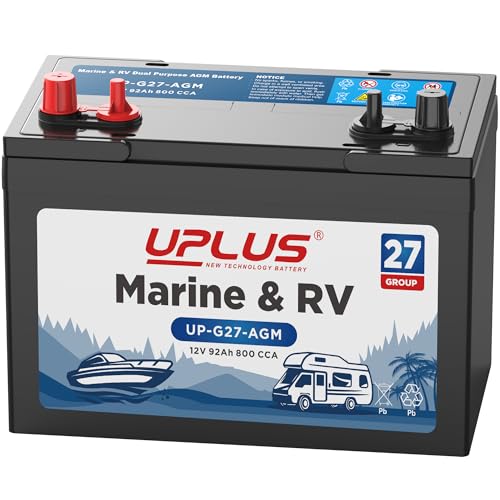
Brand: UPLUS NEW TECHNOLOGY BATTERY. 12V 92Ah, 800CCA, dual-purpose design. Dimensions approx. 12.05″ x 6.61″ x 9.11″ and around 49.16 lbs. Combines starting power and deep-cycle capability in one compact unit, aimed at saving space on boats and simplifying wiring.
Best for: Smaller to mid-sized boats where space is at a premium but you still need reliable starting power and battery endurance for accessories.
Why selected: Space-saving dual-purpose design reduces the need for two separate batteries and helps simplify mounting and wiring.
Caution: Confirm fitment for your battery compartment before purchase, given the stated dimensions and weight.
DC HOUSE 12V 100Ah LiFePO4 Trolling Motor Battery

Brand: DC HOUSE. Type: 12V 100Ah LiFePO4 with Bluetooth monitoring, Low Temp Cut-Off, and a 100A BMS. Supports up to 15,000 cycles and is designed for trolling motors, marine, and solar applications. Built-in Bluetooth app for SOC and fault monitoring.
Best for: Boats requiring long cycle life, precise SOC tracking, and smart monitoring for trolling motors or accessory loads.
Why selected: LiFePO4 chemistry delivers more cycles and stable voltage under load, with integrated safety features and remote monitoring.
Limitation: LiFePO4 batteries are typically more expensive upfront than AGM, though total cost of ownership may be lower over time due to longevity.
DC HOUSE 12V 165Ah LiFePO4 Battery
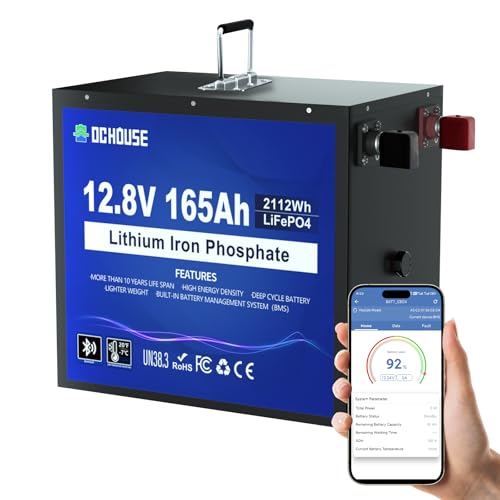
Brand: DC HOUSE. 12V 165Ah LiFePO4 with Bluetooth, Low Temp Cut-Off, and a robust metal case. Features 10-year life and up to 15,000 cycles, with a safety design including a flame-retardant shell and fault monitoring via app. Intended for trolling motors, marine, solar, and RV use.
Best for: Users who need maximum deep-cycle capacity and long service life for demanding marine power needs.
Why selected: Higher capacity supports extended trolling runs and heavier loads on larger boats or multiple accessories.
Limitation: Heavier upfront cost and installation considerations for mounting a larger LiFePO4 unit.
DC HOUSE 12V 100Ah 3.0 Trolling Motor Battery

Brand: DC HOUSE. 12V 100Ah trolling motor battery with Bluetooth monitoring, SOC indicators, USB-A, USB-C, and DC ports. Built-in 100A BMS with SOC display, and multi-port charging for devices. Designed for trolling motors, marine, and RV applications.
Best for: Boat owners who want integrated device charging alongside battery monitoring for a modern trolling setup.
Why selected: Combines a solid deep-cycle foundation with convenient USB ports and app monitoring for day-to-day boating tasks.
Limitation: Depending on usage, 100Ah LiFePO4 capacity may be consumed faster under heavy load if many devices are connected simultaneously.
Buying Guide: Key Factors to Consider
- Battery chemistry: AGM offers solid performance, lower weight than lead-acid, and good cold-crank performance. LiFePO4 provides longer life, deeper cycles, and better consistency, but at higher upfront cost.
- Capacity and weight: Match Ah rating to your boat size, trolling motor needs, and accessory load. LiFePO4 usually provides more usable capacity per weight.
- Size and mounting space: Measure compartments to ensure fitment, especially for Group 24/27 or smaller enclosures.
- Dual-purpose vs. dedicated: Dual-purpose batteries simplify wiring but may compromise optimal performance for heavy trolling or high-start demands if you push limits.
- Monitoring and safety: Bluetooth or app monitoring helps track SOC, temperature, and fault conditions. Look for BMS protection, low-temp cut-off, and case integrity features.
- Charging compatibility: Check your charger Type (AGM vs LiFePO4) and the ability to recharge quickly in rough seas or after long days of use.
- Durability and environment: Metal cases and flame-retardant shells add safety in marine environments; consider water exposure, vibration, and salt air resilience.
Frequently Asked Questions
- What battery is best for a small fishing boat? A dual-purpose AGM like the Interstate 100Ah can handle starting and trolling with fewer components.
- Are LiFePO4 batteries worth the extra cost? For boaters with long trips or frequent cycles, LiFePO4’s longer life and lighter weight often justify the higher upfront price.
- Can I mix battery chemistries on the same boat? It’s generally not recommended due to different charging and discharging characteristics.
- How do I know if a battery fits my boat’s compartment? Check exact dimensions (L x W x H) and compare with your boat’s battery tray or locker; confirm weight ratings as well.
- What maintenance is required for AGM vs LiFePO4? AGM requires minimal maintenance but may need water top-ups in some cases; LiFePO4 is nearly maintenance-free but needs monitoring for SOC and temperature.
- How long does a trolling motor battery typically last on a single charge? It depends on motor draw, boat weight, and speed; LiFePO4 generally maintains voltage longer under load than AGM.