Best Solar Vents for Boats: Top 5 Panels to Improve Cabin Air
If you’re shopping for a solar vent for your boat, you want a reliable, maintenance-free solution that keeps cabin air fresh without wiring or hassle. This guide highlights five top options designed for boats, caravans, and other enclosed spaces that benefit from solar-powered ventilation. Each pick is evaluated for best-use scenarios, easy installation, and practical limits. The buyer’s choices below include options with both battery-backed and battery-free designs to fit different needs and budgets.
Summary Table
| Product | Brand | Best For | Notes |
|---|---|---|---|
| Marine Boat 700CU FT Solar Ventilator | Pactrade Marine | Small to mid-size cabins needing battery-assisted operation | Rechargeable battery, intake and exhaust blades |
| MANANASUN Solar Ventilator 2.5W | MANANASUN | Compact spaces; simple, battery-free solar operation | No battery; on/off not present; solar-powered only |
| Marinco N20804S Day/Night Solar Vent | Marinco | Boats needing continuous airflow with rechargeable battery | 4″ model; 24/7 operation possible |
| RecPro RV Solar Ventilation Fan (White) | RecPro | RVs, boats, and sheds needing easy, wire-free setup | Quiet operation; universal fit |
| VIHOSE RV Solar Ventilation Fan | VIHOSE | Versatile and durable outdoor spaces including boats | Abs housing; UV resistant; five-blade fan |
Marine Boat 700CU FT Solar Ventilator

Best for: small to medium boat cabins that can benefit from both intake and exhaust airflow and a rechargeable battery source. This vent measures 7 1/2″ in diameter and 3″ high, making it compact enough for limited hatch spaces. It includes two blades for versatile ventilation and a built-in rechargeable battery for continuous operation when sun is available.
Selection rationale: The dual-blade design supports balanced air exchange, helping reduce musty odors and moisture buildup. The rechargeable battery offers a back-up during low-sun periods, which is helpful for boaters on cloudy days or shaded berths. A water-resistant construction adds peace of mind in marine environments.
Caution: Battery performance depends on sun exposure and charging cycles. In prolonged overcast conditions, ventilation efficiency may drop without stable power.
MANANASUN Solar Ventilator 2.5W

Best for: spaces where a simple solar-powered solution is preferred and battery-free operation suffices. This unit is powered directly by its solar panel and delivers 60 CFM airflow over a 120 mm diameter duct, suitable for small cabins or greenhouses where wiring is impractical.
Selection rationale: The absence of a battery reduces maintenance and potential failure points, making it a straightforward fit for sunny marinas or RVs requiring minimal setup. The combination of anti-UV ABS and stainless steel cover enhances durability against outdoor exposure.
Caution: No on/off switch means you cannot manually stop airflow; expect continuous operation whenever sun is available.
Marinco N20804S Day/Night Solar Vent

Best for: boat interiors that require airflow around the clock with a rechargeable battery for 24-hour operation. The 4″ model circulates up to 24,000 cubic feet of air per day, which makes it a strong option for mid-to-large cabins seeking consistent ventilation and odor control.
Selection rationale: The day/night design supports continuous ventilation, which is helpful in humid environments or during extended trips. The compact 4″ footprint fits common hatch sizes without excessive modification.
Caution: Battery maintenance should be considered to ensure continued 24-hour operation in extended stints offshore or in shaded docks.
RecPro RV Solar Ventilation Fan (White)
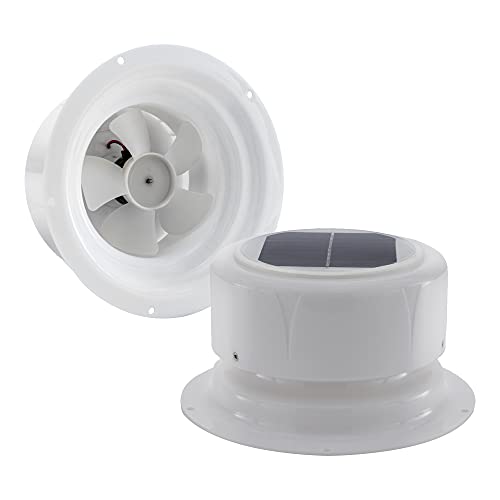
Best for: users who want universal, wire-free installation for RVs, boats, campers, or sheds. The built-in solar panel powers the fan to remove odors and moisture automatically, with a design that simplifies installation using included screws.
Selection rationale: Quiet operation and universal mounting make this a strong pick for temporary or rental boats and travel trailers, reducing the need for electrical wiring. The white finish blends with most interiors.
Caution: Performance depends on sunlight exposure; in shaded areas, airflow may decrease during the day.
VIHOSE RV Solar Ventilation Fan

Best for: durable, all-season use in RVs, boats, sheds, and trailers where UV resistance and a five-blade design improve airflow. The white ABS housing is designed to withstand sun exposure and weathering over time.
Selection rationale: The independent solar operation allows installation without wiring, while the robust construction supports long-term outdoor use. It is a versatile option when space and power wiring are limited.
Caution: Ensure compatibility with your mounting surface; some installations may require additional sealing to prevent leaks around mounting points.
Buying Guide: Solar Vents For Boats
- Power source compatibility: Decide between battery-backed and battery-free designs. Battery-backed models provide continuous operation during cloudy days or night, while battery-free models rely entirely on sunlight and are simpler to maintain.
- Vent size and airflow: Choose a vent with airflow appropriate for cabin volume. Larger cabins benefit from higher CFM ratings, while small spaces can use compact units with dual blades for balanced exchange.
- Mounting location: Consider hatch access, interior layout, and potential exposure to direct sunlight. Roof-mounted vents work well for many boats, while interior placements may need additional ducting.
- Durability and weather resistance: Look for UV-resistant housings and corrosion-resistant materials. Stainless steel components and ABS housings offer different durability profiles depending on exposure and maintenance.
- Installation effort: Universal mounting designs with simple screw-in installation help reduce setup time. Some vents include all mounting screws and basic hardware for quick use.
- Battery maintenance: If selecting a model with a rechargeable battery, factor in charging cycles, sea conditions, and potential need for battery replacement over time.
- Noise level and energy usage: Quiet operation is desirable in sleeping cabins and living areas. Solar-powered units typically run with minimal electrical draw, but fans vary in sound depending on blade design and speed.
- Maintenance needs: Regular cleaning of blades and vents helps sustain airflow. Check seals and mounting hardware for signs of wear in marine environments.
Frequently Asked Questions
- Do solar vents work at night? Battery-backed models can continue to operate after sunset if the battery has a charge. Battery-free models stop when there is no sunlight.
- How much airflow do I need? For small cabins, 60–100 CFM is typically sufficient; larger boats may require 100–200 CFM or more depending on volume and humidity levels.
- Are solar vents weatherproof? Reputable units use UV-resistant housings and moisture-resistant seals, but installation seals should be checked for marine exposure to prevent leaks.
- Can I install these myself? Most vents are designed for quick, tool-free or basic screw-in installation. Always follow manufacturer mounting guidelines.
- Will a solar vent reduce odors? Yes, by exchanging stale air for fresh air, these vents help reduce moisture buildup and musty odors in enclosed spaces.
- Which vent is best for a boat’s cabin? A model with balanced intake and exhaust airflow, plus a rechargeable battery, is typically best for continuous, reliable ventilation on boats with varying sunlight exposure.