Best Boat Battery Chargers for 2- To 3-Bank Systems in 2026
If you’re stocking up a boat or yacht, you need a reliable, multi-bank charger that can handle marine batteries, keep them healthy, and operate in harsh environments. This guide highlights five top choices designed for boaters who want safe, automated charging with flexible modes for lead-acid and Lithium varieties. Each option fits different crew sizes and electrical needs—whether you’re outfitting a small fishing skiff or a larger sailboat. Use the quick-reference table below to compare key specs at a glance.
| Product | Banks | Max Amp per Bank | Best For |
|---|---|---|---|
| NOCO Genius GEN5X2 | 2 | 5 A | Compact, two-bank setups with diverse battery types |
| NOCO Genius GEN5X3 | 3 | 5 A | Medium boat systems needing more banks |
| NOCO Genius GEN5X1 | 1 | 5 A | Single-battery maintenance on smaller craft |
| NOCO GENPRO10X2 | 2 | 10 A | Higher current, two-bank marine charging |
| SOARFLY 3 Bank 30A Charger | 3 | 10 A | Three-battery capacity with full modes |
NOCO Genius GEN5X2: 2-Bank Charger
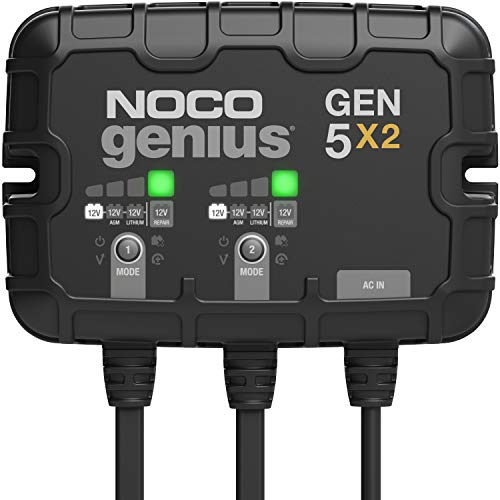
The GEN5X2 provides 10 amps total with 5 amps per bank. It supports independent charging of 12V lead-acid and lithium batteries, with selectable modes for each bank (12V, AGM, Lithium, and Repair). The charger is designed to operate in harsh marine environments and includes overcharge protection and temperature compensation. Best for boaters needing two banks with a compact footprint. Choose this if you want solid multi-bank performance without extra bulk, and you’re charging multiple batteries in parallel.
Best for: small to mid-size boats with two battery banks and mixed chemistries.
Caution: ensure proper ventilation and mounting location to manage heat in hot climates.
NOCO Genius GEN5X3: 3-Bank Charger
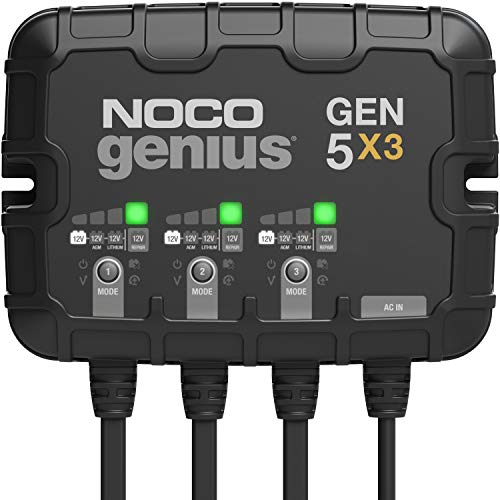
The GEN5X3 adds a third bank to the GEN5X2 design for a total of 15 amps, with 5 amps per bank. Each bank supports selectable modes for 12V, AGM, and Lithium chemistries, plus a Repair mode for maintaining or reviving batteries. This model suits boats with three separate battery zones, like a house, start, and auxiliary setup. It balances space with extra charging capacity for moderate fleets or crewed boats.
Best for: boats needing three independent banks and flexible charging modes.
Limitation: higher upfront expense versus two-bank units; ensure space fits a three-bank unit.
NOCO Genius GEN5X1: 1-Bank Charger
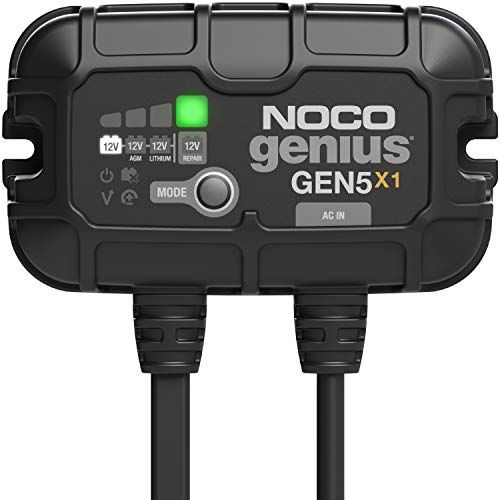
The GEN5X1 delivers a compact, single-bank 5A charging solution. It’s ideal for small boats or as a dedicated charger for a single critical battery, such as a dedicated starting or house battery. Features mirror the multi-bank models: selectable charging modes for 12V, AGM, Lithium, and a Repair mode, with temperature compensation and overcharge protection. Best for: minimal boats or as an upgrade for one- battery cruisers.
Limitation: limited to one bank, so you’ll need additional units for more batteries.
NOCO GENPRO10X2: 2-Bank 20A

The GENPRO10X2 increases per-bank power to 10 amps while maintaining two banks for a total of 20 amps. It features independent charging for marine, boat, starter, and deep-cycle systems, with mode options for 12V, AGM, Lithium, and Repair. It’s designed to handle larger loads than GEN5X2, making it a solid choice for mid-to-large boats with higher energy demands. Best for: boats needing quicker top-ups across two banks with robust marine-grade construction.
Caution: ensure your electrical system can handle the higher current draw and proper wiring is in place for two 10A banks.
NOCO Genius GENPRO10X3: 3-Bank 30A
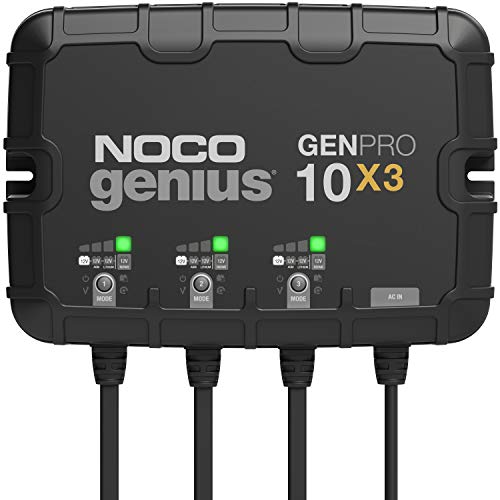
The GENPRO10X3 expands to three banks with a total of 30 amps — 10 amps per bank. Each bank supports 12V, AGM, Lithium, and Repair modes, making it capable of managing multiple battery types on larger boats. This model suits crews with three separate battery operational zones or higher daily energy use. Best for: larger boats needing strong, flexible multi-bank charging with fast replenishment.
Limitation: larger footprint; verify cabinet or cockpit space accommodates a three-bank unit.
Buying decisions should weigh bank count, per-bank current, battery chemistry support, and installation space. The options above are all designed for marine environments with corrosion-resistant builds and advanced safety features such as overcharge protection and temperature compensation. When choosing, consider how many battery zones you maintain, expected charging speed, and whether you’ll upgrade to Lithium or keep lead-acid variants.
Buying Guide: Key Considerations For Marine Battery Chargers
- How many banks do you need? Two-bank units are compact for small boats; three-bank units suit mid-size systems with more than two battery zones.
- What battery chemistries will you charge? Look for selectable modes for lead-acid, AGM, Li-ion/LiFePO4, and a Repair/Desulfate option for older batteries.
- What is the maximum current per bank and total? Higher per-bank amps reduce charging time; ensure your bateau’s wiring supports the current safely.
- Is the charger waterproof or weatherproof? Marine-rated units typically feature IP ratings and sealed enclosures for salt spray exposure.
- What about temperature compensation? Temperature-based charging preserves battery health in varying climates aboard.
- Installation considerations: mounting space, ventilation, and accessible mode controls are important for everyday use and dead-battery recovery scenarios.
FAQ
- How many banks should I choose for a small boat? A two-bank charger is typically enough for a small boat with two batteries and simple setups.
- Can these chargers maintain lithium batteries? Yes, many models include selectable Lithium modes and temperature compensation for LiFePO4 chemistries.
- What is “Repair Mode” used for? Repair Mode helps recover deeply discharged or damaged batteries by slowly applying current to revive them.
- Do marine chargers need special installation? Yes, follow manufacturer wiring diagrams and consider professional installation if you’re unsure about electrical safety on a boat.
- Will these chargers work in saltwater environments? Marine-grade units are designed for harsh marine environments, including exposure to salt spray when properly mounted.
- Are there safety features to prevent overcharging? Most models include overcharge protection and temperature compensation to prevent battery damage.