Best Spray Foam for Boats: Buoyancy, Insulation and Easy Application
When choosing spray foam for boats, you want a product that provides buoyancy, resists marine conditions, and can be applied in tight spaces. This guide highlights five reputable options, explains who they suit best, and compares their core benefits. It’s ideal for boat builders, retrofitters, and DIY enthusiasts aiming to improve flotation, insulation, or void filling on watercraft.
| Product | Brand | Best For | Key Benefit |
|---|---|---|---|
| TotalBoat Flotation Foam – 2 Part | TotalBoat | Buoyancy and insulation on small to mid-sized boats | High closed-cell content for flotation |
| TotalBoat 2 Lb Density Kit | TotalBoat | Flotation, insulation, and soundproofing on decks | 1:1 mix, fast cure, 94% closed cell |
| Fiberglass Supply Depot 6 Lb Density Kit | Fiberglass Supply Depot | Heavy-duty flotation or structural void filling | Very high density and rigidity |
| Fiberglass Supply Depot 2 Lb Density Quart Kit | Fiberglass Supply Depot | Lightweight buoyancy and insulation in cavities | 2 lb density, easy to carve |
| Oycevila 2 Gallon Kit | Oycevila | Fence post foam-inspired flotation in marinecraft | Excellent flotation support in a user-friendly kit |
TotalBoat Flotation Foam – 2 Part Expanding Foam

This two-part, polyurethane pour foam is designed for marine flotation, insulation, and soundproofing, with a focus on nonstructural applications. It expands on cure to fill voids and creates a lightweight yet buoyant structure. The foam is typically used to reinforce decks, fill gaps, and provide buoyancy in small to mid-sized vessels. It’s especially suited for boats where quick curing is desired and where cured foam will be coated with resin or painted later.
Best for: boat owners and small builders needing reliable flotation and acoustic sealing. Choose this if you need a fast-setting solution that remains workable in multiple layers for large voids. Avoid if you require structural rigidification beyond buoyancy, as it’s specifically nonstructural.
Caution: Ensure proper ventilation and protective gear during mixing and curing. The foam is lightweight but expands significantly, so plan product placement to avoid unintended gaps or pressure on delicate hull areas.
TotalBoat 2 Lb Density Expanding Foam Kit

This 2-pound density, two-part closed-cell polyurethane foam is crafted for marine applications, delivering buoyancy, insulation, and soundproofing. It cures to a rigid, water-resistant foam that can be coated with fiberglass resin. It’s great for filling under decks, voids, and gaps while maintaining buoyancy. It is considered nonstructural, so it supports buoyancy and thermal management rather than structural reinforcement.
Best for: boat builders and DIYers needing a reliable, lightweight flotation solution with good water resistance and easy layering. Better for projects where a fast cure and subsequent coating are planned. Caution: avoid using this for load-bearing structural applications where rigidity is essential beyond buoyancy.
TotalBoat 6 Lb Density Expanding Foam Kit
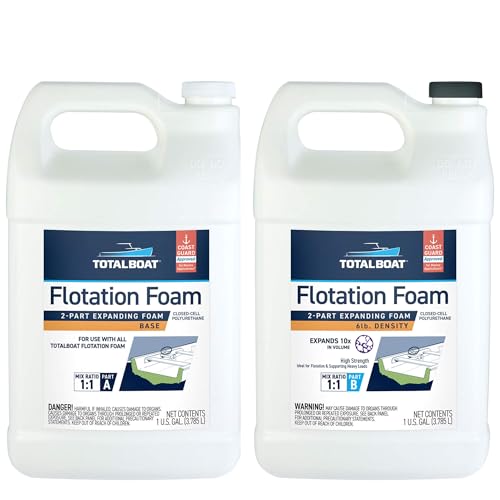
This high-density foam kit is designed for heavy-duty flotation, carving, and structural support. It cures into a very hard, rigid foam with a 94% closed-cell content, offering strong moisture resistance and compatibility with common marine resins. It’s suitable for tougher applications such as larger flotation blocks, castings, or custom part fabrication on boats and buoys.
Best for: applications requiring substantial buoyancy, rigidity, and durability. Better for projects where foam will be coated or integrated into heavier structures. Caution: higher density means heavier handling and longer cure times; plan your work area to accommodate the material’s volume.
Fiberglass Supply Depot 6 Lb Density Kit

This 6-pound density, two-part polyurethane foam is highly suitable for flotation, carving, and solid void filling, offering rigidity and impact resistance. It yields a high-density foam that can be laminated with resins after curing, making it versatile for both buoyancy and decorative or structural projects. It is best for applications that require long-lasting buoyancy and form stability.
Best for: serious flotation and reinforcement tasks where robust rigidity matters. Better for grander marine installations or where foam will be shaped and coated. Caution: heavier foam means careful handling and precise mixing to avoid overexpansion in tight spaces.
Oycevila 2 Gallon Kit

This two-gallon kit uses a two-pound density polyurethane foam designed to deliver strong flotation while remaining relatively easy to apply in tight spaces. It mirrors fence post foam formulas adapted for marine flotation, trapping air in a closed-cell structure to boost buoyancy. It also functions as insulation for marine refrigeration and bait wells.
Best for: small- to mid-sized boats needing reliable buoyancy and insulation with a forgiving mix ratio. Better for DIY projects that require a balance of ease of use and adequate rigidity. Caution: ensure adequate ventilation and workspace clearance to manage expansion safely.
Buying Guide: Key Considerations For Marine Foam
- Density and buoyancy needs: Higher-density foams deliver stronger rigidity and flotation, but are heavier and may be harder to work with in tight spaces.
- Closed-cell content: Look for high closed-cell percentages (around 90-94%) for marine buoyancy and water resistance.
- Cure time: Shorter cure times enable faster project completion, but may require quicker working during mixing and application.
- Coating compatibility: Many marine foams must be coated with polyester, epoxy, or vinyl ester resins to seal and protect the foam from water exposure.
- Nonstructural vs. structural use: Most boat foams are designed for flotation and insulation, not structural reinforcement. Verify suitability for your intended load-bearing needs.
- Handling and safety: Follow ventilation guidelines, protect skin and eyes, and plan for expansion behavior to prevent unintended gaps or pressure on hull components.
Frequently Asked Questions
- What is the main purpose of marine spray foam? It provides buoyancy, insulation, and void filling for boats and floating structures.
- Can I coat marine foam with resin? Yes, many foams are designed to be coated with polyester, epoxy, or vinyl ester resins after curing.
- Is all spray foam suitable for boats? No, choose products labeled for marine use or approved for flotation and insulation in marine environments.
- What density is best for flotation? Higher density foams offer more rigidity and durability but weigh more; balance with project requirements and space.
- How long does it take foam to cure? Cure times vary; typical marine foams reach handling stiffness in about 5–15 minutes to allow layering, with full cure over several hours.
- Are there safety concerns when applying marine foam? Yes; work in a ventilated area and use protective gear during mixing and curing to avoid fumes and skin contact.