Best Marine Fresh Water Pump Solutions for Reliable Onboard Water Delivery
When selecting a marine fresh water pump, you want dependable flow, stable pressure, and quiet operation that fits your boat, RV, or caravan. This guide highlights five pumps well suited for RVs, boats, and off‑grid setups, explaining who each is best for and why. The top choices range from compact 12V units for small systems to higher‑capacity models for larger rigs. Use the summary table to compare key specs at a glance.
Quick comparison at a glance
- Best overall 12V pump for mid-sized systems: WASSERMANN RV Pump
- Best for pedal-to-the-metal demand and quiet operation: SEAFLO 55 Series
- Best off-grid diaphragm option with strong head: Gidrox 12V 4.0 GPM
- Best high-flow upgrade for larger RVs or boats: MRGVFLO Upgraded 7GPM
- Best value 12V option with smart pressure control: Jabsco ParMax HD4-12V
WASSERMANN RV Pump, 12V Self-priming 4.0GPM 45PSI

Best for compact to mid-sized marine or RV systems where steady 45 PSI is sufficient for faucets, showers, and small appliances. This pump includes a complete kit with adapters, a debris filter, and a user manual, saving setup time. It runs on 12V DC and works from an RV battery or cigarette lighter socket, making it ideal for mobile installations. Potential buyers should note it is designed for 12V operation and may require additional battery support for extended use.
Key details:
- Flow: up to 4 GPM; Pressure: 45 PSI
- 12V DC motor with 12V battery or vehicle lighter power
- Includes fittings, filter, and manual
Who it’s best for: Small to medium RVs, campers, boats, and off-grid setups needing reliable, moderate pressure without heavy equipment. Choose this if you want a ready-to-install package with necessary accessories included.
One caution: The unit’s performance depends on proper wiring and adequate battery power; ensure your electrical system can sustain peak current during operation.
ECO-WORTHY 33-Series 110V Diaphragm Pump
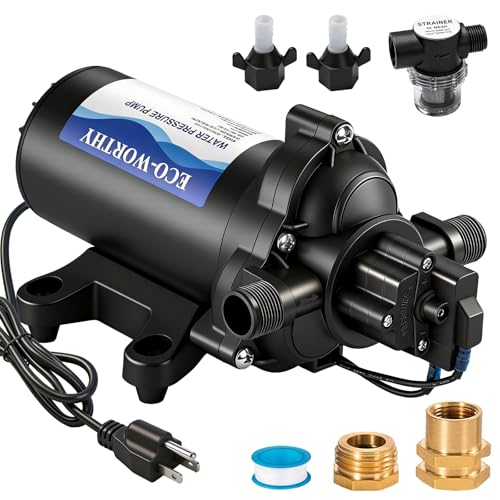
Best for scenarios where 110V AC power is readily available on shore power or a generator, eliminating the need for a battery. Its 4.0 GPM capacity and 50 PSI shut-off support consistent water delivery for irrigation, boating, or larger RV water systems. It features a smart pressure switch and a wide adjustable range, offering flexible operation for varying faucet demands. This is a robust option for longer-term, stationary installations in marinas or campsites.
Highlights:
- Diaphragm pump with 110V AC power
- 4.0 GPM, 50 PSI shut-off, adjustable 45–70 PSI
- Self-priming, suitable for marine and RV plumbing
Best for: Boats or RVs with reliable shore power access or a portable generator, where a higher flow is desired without relying on a vehicle battery. Consider this for garden-hose or larger onboard water consumption needs.
Limitation: Requires 110V AC power supply; not ideal for fully off-grid or battery-powered systems.
SEAFLO 55 Series 12V RV Water Pump

Best for steady, high-flow needs in RVs or boats with a 12V system. This 5.5 GPM pump delivers 60 PSI, supports a reliable self-priming function, and includes a built-in bypass and a robust warranty. It’s engineered to meet potable water safety standards and is designed for longer, dependable operation in demanding freshwater systems. The model is suited for users who want substantial output without compromising quiet operation.
Notable features:
- 5.5 GPM at 60 PSI
- 12V DC with built-in bypass; quiet operation
- NSF/UL standards for RV potable water and 4-year warranty
Who should consider this: Medium-to-large RVs, cruisers, or off-grid setups where a higher flow supports showers, sinks, and appliances simultaneously. Pick this if you need reliable performance with a long warranty.
Caution: Ensure compatibility with existing plumbing fittings and available electrical capacity; the higher current may demand a larger fuse or breaker in some installations.
Gidrox 12V RV Water Pump, 4.0 GPM 45 PSI

Best for off-grid travel with quiet, low-noise operation and reduced vibration. This unit emphasizes a balance between performance and practical onboard use, featuring a 10 ft self-prime capability and 100 ft head pressure. It also highlights noise reduction technology and a vibration-damping base, making it a strong choice for compact living spaces where noise matters.
Core points:
- 4.0 GPM at 45 PSI; 10 ft self-prime; 100 ft head
- Noise-reducing design with vibration dampers
- Off-grid suitable and dual safeguards against overheating
Best for: RVs and boats seeking unobtrusive operation in tight spaces plus dependable water pressure for daily use. Opt for this if you value quiet performance and off-grid reliability.
Limitation: The unit’s efficiency depends on correct plumbing layout and avoiding excessive inlet pressure; follow the included installation guidance to prevent leaks.
[Upgraded Version] MRGVFLO 12V RV Pump, 7GPM 70PSI
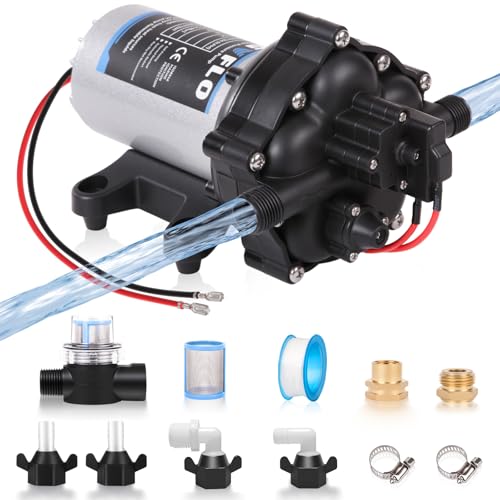
Best for larger systems requiring high flow and robust pressure. The five-chamber diaphragm design with NSK double ball bearings supports smooth, high-capacity delivery. It includes automatic pressure control to minimize wear and conserve energy, and it’s designed for 12V operation compatible with typical RV or marine battery setups. Suitable for showers, sinks, and multiple fixtures simultaneously in sizable onboard water networks.
Highlights:
- 7 GPM at 70 PSI; five-chamber diaphragm
- Automatic pressure switch; quiet operation
- Off-grid friendly and corrosion-resistant materials
Who should choose this: Large RVs, sailboats, or marinas with high water demand where maximum continuous flow matters. Choose this when you want ample pressure and volume for multiple outlets.
Buying Guide: How To Pick The Right Marine Fresh Water Pump
What size system do you have?
Estimate your total water demand: the number of outlets, typical usage, and whether you need simultaneous flow for several fixtures. For compact setups, a 4.0–5.5 GPM pump at 45–60 PSI is usually sufficient. Bigger systems may require 7 GPM at 70 PSI or more, especially if you have multiple showers or long hose runs.
Power source considerations: 12V DC vs 110V AC
12V pumps work off your battery and are ideal for off-grid use. 110V pumps run from shore power or a generator and remove the battery load but require a power source. For shore-power-dominant vessels, 110V options can be convenient; for truly mobile setups, 12V is essential.
Is noise a concern?
Look for pumps marketed with noise reduction features or anti-vibration bases. Quiet operation improves onboard comfort, particularly in cabins and small boats where sound travels easily.
Self-priming and head pressure
Self-priming capability helps with non-level installations and longer hose runs. Head pressure (max vertical lift) determines how high water can be delivered and how far it can push uphill. If your plumbing has high fixtures or long runs, pick a pump with higher head pressure.
Materials and safety
For potable water, ensure the pump components meet safety standards (NSF/UL, etc.) and that seals are corrosion-resistant to withstand saltwater exposure. A built-in debris screen or easy-to-clean filter helps protect the pump from particulates.
Maintenance and warranty considerations
Check for a reasonable warranty period and ease of service. Look for accessible diaphragms, replaceable seals, and clear installation manuals. Regular inspection and simple replacement parts extend pump life in marine environments.
FAQ
- What is a typical 12V RV water pump flow rate? Most 12V pumps provide 4.0–5.5 GPM, with variations up to 7 GPM in higher-capacity models. Choose based on your outlet count and usage.
- Do I need a booster pump for my RV? Booster pumps are useful if you experience low water pressure due to long hose runs or multiple outlets. For moderate systems, a standard 4.0–5.5 GPM pump is usually sufficient.
- What PSI should my marine pump deliver? Typical potable water needs run around 45–60 PSI. Higher PSI may improve shower and faucet performance but increases wear and electrical draw.
- Can I install a 110V pump on a boat? It’s possible if you have reliable shore power or a generator. Ensure electrical safety and proper wiring to prevent shock hazards and overloads.
- Are these pumps suitable for saltwater environments? Many are designed with corrosion-resistant components, but regular inspection and proper maintenance are essential in saltwater settings.
- What maintenance helps extend pump life? Clean filters, inspect fittings for leaks, ensure proper venting, and replace worn diaphragms or o-rings as needed.