Best Marine Fuel Tank Sending Units for Accurate Tank Gauges in 2026
Answering the common buyer question: which marine fuel tank sending unit best fits your boat, RV, or vehicle fuel system? This guide compares top picks that translate tank depth and fuel level into a reliable gauge reading. The highlighted options cover common depths from 4″ to 13″ and standard 33-240 ohms ranges. Ideal buyers include boat owners replacing a failed sending unit, RV users needing a durable marine-grade sender, and DIY installers seeking easy installation with clear wiring instructions. Below you’ll find a concise product table, followed by detailed sections to help you choose with confidence.
| Product | Depth Range | Ohms | Best For |
|---|---|---|---|
| Marine Fuel Tank Sending Unit — CLLOMAGY | 4″–28″ | 33–240 | Compact tanks; flexible trimming |
| Marine Fuel Sending Unit — CLLOMAGY | 6″–12″ | 33–240 | Mid-depth tanks; adjustable |
| Moeller 035722-10 | 6″–12″ | 33–240 | Industry-standard replacement |
| 100TECH 240-33 Ohms 11″ | 11″ | 240–33 | Stainless steel; durable reed switch |
| 100TECH 240-33 Ohms 8″ | 8″ | 240–33 | Compact form; easy install |
Marine Fuel Tank Sending Unit, 4–28 Inch Depth

Best for smaller to mid-size tanks with flexible depth needs. This unit is described as a replacement for broken sending units in marine fuel tanks and can display water and fuel level information for boats, RVs, cars, and trucks. It is adjustable by cutting to fit tank depth and can rotate for tight spaces when the center screw is loosened and re-tightened. It suits buyers who need a versatile, easier-to-fit sender that can be tailored on-site.
Best for budget-conscious DIY installers who require an adjustable, easy-to-fit unit. The main limitation is a potential fit variation due to tank shape, so precise measurement before cut is advised.
Marine Fuel Sending Unit for 6–12 Inch Tanks

Better for mid-depth tanks in boats and vehicles where a standard 33–240 ohm gauge is used. Like the first CLLOMAGY option, it supports flexible installation in tight spaces and is designed as a direct replacement for broken sending units. It’s a solid choice for users who prioritize compatibility with common gauges and straightforward installation.
Best for replacing a worn unit without major rewiring. One caution is to confirm your tank’s depth and gauge compatibility to ensure accurate readings after installation.
Moeller 035722-10 Fuel Tank Sending Unit

Best for users seeking an industry-standard replacement with corrosion-resistant internal components. It is calibrated to the industry standard 33-240 ohms and requires a dash-mounted gauge connection. The unit’s internal parts resist rust and corrosion, making it a durable option for marine environments.
Choose this if your system already uses a standard gauge and you want a robust, long-lasting replacement. A potential limitation is that it emphasizes standard gauge compatibility, so verify your dashboard gauge type before purchase.
100TECH Fuel Sending Unit, 11″ Depth

Best for longer tanks, offering a stainless steel body and a reed switch for durability. It uses 240–33 ohms output, with no moving parts to break. The kit includes gasket and mounting screws, and wiring instructions are provided for straightforward installation.
Choose this if you want a high-durability unit with reliable reed-switch technology. A limitation is that longer lengths require confirmation of tank depth to ensure proper fit.
100TECH Fuel Sending Unit, 8″ Depth
Best for compact tanks where space is limited but a 240–33 ohm reading is required. It uses the same durable reed switch design and includes mounting hardware and clear instructions for installation. It’s a practical option for smaller boats or RV tanks.
Caution: verify the exact tank depth to avoid over-shortening, which could lead to gauge inaccuracies.
BOSCH SP0F000013 Fuel Level Sender
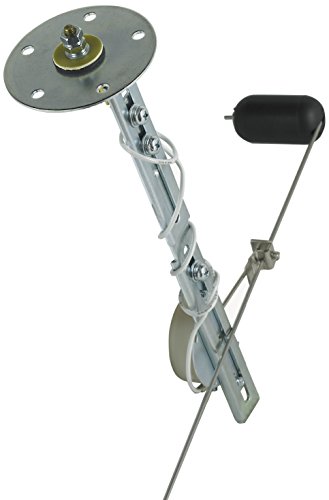
Best for installations requiring compatibility with Bosch gauges and deep tanks up to 26 inches. The unit includes gasket and mounting hardware. This makes it suitable for original equipment replacements where Bosch compatibility is essential.
Choose this if you’re using a Bosch gauge system. A potential limitation is its deeper tank range, which may be unnecessary for shallower tanks if not needed.
RUPSE Fuel Sender Unit, 12″ Depth

Best for high-precision and long life. The exterior stainless steel body and corrosion-resistant reed switches provide a stable output signal. It supports multiple fuel types and offers eight backlight color options for easy readability in various lighting conditions.
Best for users who want a premium, durable option with better visibility under diverse conditions. Limitation: higher price point relative to basic models may be a consideration for some buyers.
Moeller 12″ Depth Reed Switch Fuel Sending Unit

Best for slightly deeper tanks around 13″ depth, where the float remains accurate as the gauge reads. The product is designed with a 12″ sending unit for a 13″ tank depth, keeping the float position aligned with the gauge reading.
Choose this if your tank depth sits near 12–13 inches and you need a precise alignment between float and gauge. Limitation: it is specific to a 13″ depth; ensure it matches your tank measurements before purchasing.
Buying Guide
- Tank depth compatibility: Measure the actual tank depth and choose a sender that covers or closely matches that range.
- Ohm range: Most marine gauges use 33–240 ohms. Confirm your gauge’s input range to avoid reading errors.
- Material and durability: Stainless steel bodies and reed switches improve corrosion resistance in saltwater environments.
- Installation ease: Look for kits that include gaskets, mounting screws, and straightforward wiring diagrams.
- Gauge compatibility: Some units are designed for Bosch or Moeller gauges. Verify gauge brand compatibility to ensure accurate readings.
- Adjustability: Flexible units that can be trimmed or rotated help with tight spaces and non-standard tank shapes.
FAQ
- What does 33–240 ohms mean in a fuel sending unit?
– It describes the electrical resistance range indicating empty to full; ensure your gauge is designed for this range. - Can I install a sending unit in any fuel tank?
– Most are designed for marine tanks but require correct depth, mounting pattern, and gasket compatibility with your gauge. - Do I need professional help for installation?
– Simple replacements can be DIY with included instructions, but consult a professional if you’re unsure about wiring or tank sealing. - Are there units suitable for deep tanks?
– Yes, several options cover depths up to 13 inches and beyond; verify the tank depth before purchase. - Will a stainless steel sender rust?
– Stainless steel and corrosion-resistant reed switches are designed to resist rust in marine environments. - What should I avoid when buying a sending unit?
– Avoid units that don’t match your gauge type, tank depth, or mounting pattern.