Best Fuel Tanks for Boats: Safe, Portable Boat Gas Cans for Extended Runs
Answering the needs of boaters who want reliable, portable fuel options, this guide highlights five top fuel tanks that are specifically designed for boats. These options cater to different vessel sizes, fuel capacities, and refueling workflows. The best choice depends on boat type, typical trip length, and how you prioritize built-in gauges versus portability. The table below summarizes the five products covered and their ideal use cases to help you choose quickly.
| Product | Capacity | Best For | |
|---|---|---|---|
| Scepter 12 Gallon Portable Marine Gas Can (08668) | 12 Gallons | Longer runs on mid-size boats | Built-in fuel gauge and 2-way vented cap |
| VEVOR Marine Tank | 14.53 Gallons | Outboard adventures with visible gauge | 9.8 ft hose; high-density polyethylene |
| Scepter 9 Gallon Portable Marine Gas Can (08667) | 9 Gallons | Compact boats or as a secondary tank | Built-in gauge and 2-way vented cap |
| AloneGoer 3 Gallon Portable Boat Fuel Gas Tank | 3 Gallons | Yamaha outboards or as a spare tank | HDPE-EVOH-HDPE multi-layer barrier |
| LAUCO Portable Marine Fuel Tank | 6.34 Gallons | Under-seat storage and quick refills | Two venting options; 9.8 ft hose |
The following sections detail each product’s strengths, who should consider them, and practical limits to be aware of when selecting a marine fuel tank.
Scepter 12 Gallon Portable Marine Gas Can

Capacity, portability, and a practical fueling workflow define the Scepter 12 Gallon model. It offers a large 12-gallon reservoir and a built-in fuel gauge for quick checks, making it ideal for mid-sized boats or anglers who need longer running times without frequent refueling. The two-way vented cap supports airflow during fueling and automatically relieves pressure above 5 PSI to prevent vapor buildup. This model accepts standard 1/4 NPT marine fittings, which broadens compatibility with common fuel lines. It is best for boaters who prioritize a single, high-capacity tank with integrated monitoring. Caution: avoid overfilling near hot engines to minimize spill risk. Best for: boats needing substantial range without swapping tanks mid-trip. Limitations: the tall profile may be less convenient for under-seat storage on smaller vessels.
VEVOR Marine Tank, 14.53 Gallons

The VEVOR tank emphasizes capacity and a clear fuel gauge for visibility, with a robust 14.53-gallon capacity. Its 9.8-foot hose is designed to connect to common fittings, though compatibility notes specifically mention Yamaha connectors. This model suits anglers and small- to mid-sized boats that need a substantial reserve, along with a long hose to reach docking stations or deck storage. A key advantage is its visible gauge, which supports precise fuel planning. Caution: avoid direct sunlight for extended periods to prevent aging. Best for: boats needing a visible gauge and ample capacity; better for planners who want to minimize trips to refuel. Limitation: hose compatibility is specialized for Yamaha connections.
Scepter 9 Gallon Portable Marine Gas Can

This 9-gallon model offers a compact option with a built-in gauge and a two-way vented cap designed to control vapor during refueling. It’s well-suited for smaller boats or as a secondary tank to extend range on longer days on the water. The design supports diesel and ethanol-blended fuels, which adds flexibility for mixed-fuel setups. Best for: boaters needing a space-saving, reliable fuel tank with straightforward fuel level checks. Limitation: capacity is lower than larger units, which may necessitate more frequent refueling on longer trips.
AloneGoer 3 Gallon Portable Boat Fuel Gas Tank
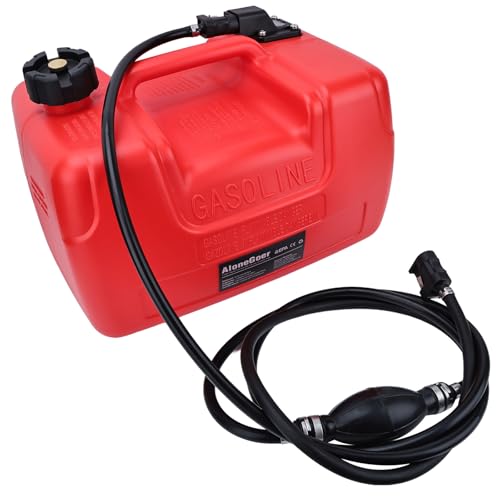
The AloneGoer option is a compact 3-gallon tank designed specifically for outboard motors and as a spare fuel tank on board. It features a multi-layer barrier technology—HDPE-EVOH-HDPE—that significantly reduces fuel permeation and evaporation compared with standard tanks. This makes it appealing for salt spray environments and high-humidity boats where durability matters. Best for: outboard-powered small boats needing a lightweight, durable spare or primary small-capacity tank. Caution: the smaller capacity requires mindful fuel management on longer trips.
LAUCO Portable Marine Fuel Tank, 6.34 Gallons

The LAUCO tank combines a substantial 6.34-gallon capacity with practical venting options and a molded top handle for easy transport. Its dual vent design enables either sealed or vented operation, depending on fueling needs, and comes with a long hose to reach fuel ports without moving the boat. Best for: boaters who want flexibility between vented and sealed operation and a compact size that still provides meaningful capacity. Limitation: ensure the tank is stored away from prolonged sun exposure to minimize aging and expansion.
Buying Guide
What capacity do you actually need? Choose based on typical trip length and refueling opportunities. Larger tanks reduce the number of refills but take up more space and can be heavier to move on shore.
How important is a built-in gauge? Tanks with integrated gauges simplify fuel planning and reduce guesswork. If a gauge isn’t built-in, you’ll rely on external indicators or careful measurement.
Are vented or sealed caps preferred? Vented caps help manage vapor and pressure during fueling, while sealed caps minimize evaporation in storage. Consider your climate and storage conditions when choosing.
What about hose length and compatibility? A longer hose increases reach from the fueling point to your tank, but compatibility with your boat’s fittings matters. Check connector types (for example Yamaha compatibility) before purchasing.
Durability and material matter in saltwater environments. High-density polyethylene (HDPE) tanks resist aging and corrosion better in humid, salted air. Look for UV-stabilized materials for longevity in sun-exposed decks.
Storage and placement considerations: some tanks are designed to fit under seats or in tight compartments, while others are tall and may require more headroom. Measure the storage space on your vessel before buying.
FAQ
- Which fuel tank is best for long day trips? The Scepter 12 Gallon offers the largest capacity among the listed options and includes a built-in gauge, making it a strong choice for longer runs between refuels.
- Do these tanks support diesel fuel? Several models specify compatibility with diesel and ethanol blends; always verify the specific model’s fuel compatibility before use.
- Is a visible fuel gauge necessary? A built-in gauge helps you avoid surprises, especially on longer trips where fuel availability is limited.
- Can I use these tanks under-seat? Some designs are slim enough for under-seat storage, while others have a taller profile; check the exact dimensions for your vessel’s layout.
- What maintenance is required? Keep vents clean and ensure caps seal properly to minimize evaporation and leak risks in storage and transit.
- Are there safety considerations for vented caps? Vented caps relieve vapor pressure during fueling but should be used in suitable environments to prevent accidental spills or exposure.