Best Water Pumps for Boats: Onboard Freshwater and Bilge Solutions
Direct answer: for on-boat use, select pumps that match your power source (AC vs. 12V), desired flow rate, and whether you need automatic on-demand operation or manual priming. The top picks below cover onboard freshwater delivery, bilge pumping, and reliable, duty-cycle ready options suitable for most small to mid-size boats. Best for RV or marine users needing automatic pressure switches are the diaphragm pumps with built-in safeguards. Best for small craft and emergencies are hand bilge pumps for simple, manual operation.
Buyer-friendly summary: the five products highlighted here offer a mix of AC and DC power, self-priming capability, and different pressure ratings. Use this guide to pick a pump based on whether you prioritize on-demand water supply, bilge removal capacity, or quiet operation on quiet nights at anchor. The table provides quick comparisons to help you decide which model fits your boat layout and electrical setup.
| Product | Type | Flow | Pressure | Power |
|---|---|---|---|---|
| ECO-WORTHY 33-Series Industrial Water Pressure Pump | AC Diaphragm Pump | 4.0 GPM | 50 PSI (adjustable 45–70 PSI) | 110V AC |
| SEAFLO 33 Series | AC Diaphragm Pump | 3.3 GPM | 45 PSI | 115V |
| ECO-WORTHY 110V Transfer Diaphragm Pump | AC Diaphragm Pump | 5.5 GPM | 70 PSI | 110V AC |
| DC HOUSE 12V RV Water Diaphragm Pump | DC Diaphragm Pump | 3.5 GPM | 45 PSI | 12V DC |
| Subtoy 12V Automatic Boat Bilge Pump Kit | DC Bilge Pump | 1100 GPH | — | 12V DC |
ECO-WORTHY 33-Series Water Pressure Pump
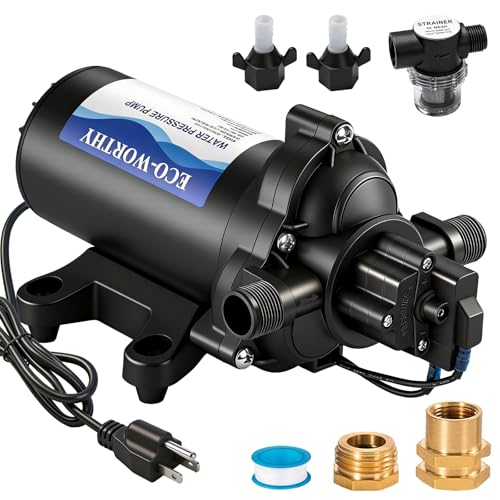
The ECO-WORTHY 33-Series is an AC-powered diaphragm pump tailored for marine freshwater delivery. It self-starts via a smart pressure switch, turning on at demand and shutting off when faucets close. It supports a 4.0 GPM flow and is designed for quiet operation with an adjustable pressure range of 45–70 PSI. It is self-priming up to 9.8 feet and can lift water up to 131 feet, making it suitable for boat installations where the water tank is above the pump.
Best for: boats needing automatic freshwater supply from a pressurized system without relying on a boat battery. It suits vessels that require a steady, moderate flow with simple installation.
Caution: monitor thermal protection in high-temperature environments; the pump will disconnect if the temperature rises above 95°C to protect the motor.
SEAFLO 33 Series 110V Water Pump

The SEAFLO 33 Series delivers 3.3 GPM at 45 PSI with a built-in smart pressure switch. It’s NSF/ANSI and UL-listed for potable water applications, making it credible for boats that prioritize drinking-water safety standards. The unit is designed for RVs, boats, and off-grid applications where consistent freshwater pressure is necessary.
Best for: boaters who need NSF/UL-approved potable-water compatibility and a robust, self-priming design in a compact package.
Limitation: it operates at a higher price point than some basic pumps and requires a suitable 115V power source aboard.
ECO-WORTHY 110V Fresh Transfer Diaphragm Pump

This 5.5 GPM, 70 PSI diaphragm pump is designed for on-demand transfer, with a self-priming capability up to 9.8 vertical feet and lift up to 131 feet. The unit emphasizes a quiet and safer operation thanks to a thermal-overload protection feature and an upgraded pressure switch designed to last longer. It’s well-suited for garden irrigation, RV water supply, and on-boat transfer tasks where a dependable water boost is needed.
Best for: boaters who require a higher transfer rate for rapid fill-ups or ballast management while maintaining a low-noise profile.
Caution: ensure your boat’s electrical system can handle the 1.6 A draw and verify mounting clearance for the pressure switch.
DC HOUSE 12V RV Water Diaphragm Pump
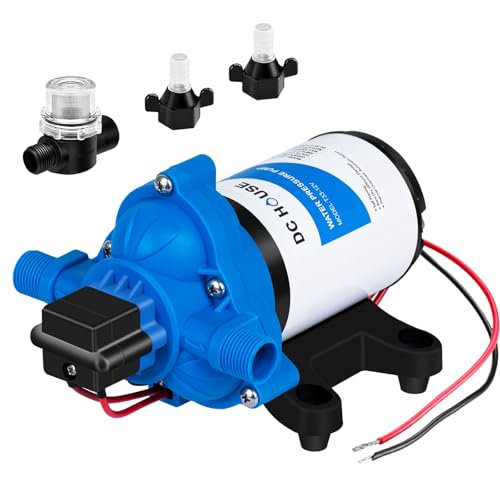
This 12V pump runs on-demand with an adjustable switch set at 45 PSI. It features self-priming up to 9.8 feet, lifting water up to 131 feet, and includes thermal protection to prevent motor damage. Its quiet operation makes it a practical option for RVs, campers, and boats with a 12V power system.
Best for: boats with stored freshwater and a 12V power setup aiming for compact, on-demand pressure without an AC supply.
Limitation: 12V systems require a reliable boat battery or solar setup; plan for potential battery drain during extended use.
Subtoy 12V Automatic Bilge Pump Kit
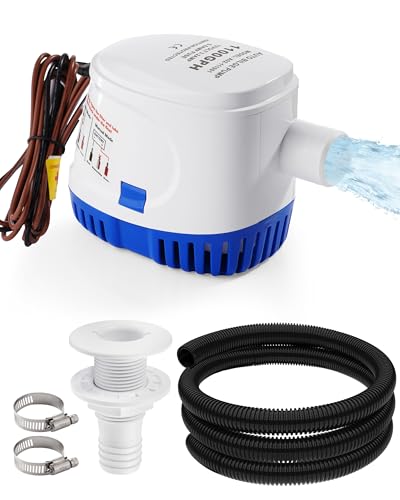
The Subtoy kit provides a 1100 GPH bilge pump with a built-in float switch for automatic on/off operation, plus hoses and a thru-hull fitting. Fully submersible construction adds durability for marine use, and the high capacity helps manage bilge water quickly in rough conditions. It’s a practical choice for boats needing straightforward bilge management.
Best for: boaters seeking a complete, ready-to-install bilge solution with automatic activation and quick setup.
Caution: consider compatible mounting space and ensure the included fittings match your hull design to prevent leaks.
Buying Guide
What to consider when choosing a water pump for your boat
Power source: Choose between AC-powered pumps for shore-power setups and 12V DC pumps for boats with battery or solar capabilities. AC pumps generally offer higher flow without draining batteries; DC pumps suit mobile or off-grid boats.
Flow rate and pressure: Match flow (GPM) and shut-off pressure (PSI) to your needs. Higher PSI is useful for long runs or higher faucet heads, while lower PSI can reduce wear on fittings and improve efficiency in small systems.
Self-priming and lift: A good on-boat pump should be self-priming up to several feet and capable of lifting water from tanks located below the pump. Plan for the tank-to-pump elevation in your installation.
Automatic vs. manual: Pumps with smart pressure switches enable automatic operation when a faucet is opened. Manual bilge pumps are reliable backups for emergencies or simple tasks where automation isn’t needed.
Safety and certifications: If potable water is involved, consider pumps with NSF/ANSI standards and proper certifications. Thermal protection is valuable to prevent motor damage in hot engine compartments.
Durability and installation: Look for corrosion-resistant materials and sealed housings for bilge or saltwater environments. Ensure hose compatibility and available fittings for your boat’s plumbing plan.
Frequently Asked Questions
- What pump should I use for onboard freshwater supply? A diaphragm or impeller pump with a smart pressure switch is ideal for automatic, pressurized water delivery from a water tank.
- Can I use a 12V pump on a boat without a battery? Not recommended. A 12V pump requires a power source (battery or solar) to operate.
- Is a higher PSI pump always better? Not necessarily. Higher PSI is beneficial for long piping runs or high faucet heads, but it can increase wear and power use. Choose based on system needs.
- Do I need a pump with NSF/UL standards? For drinking-water lines, select pumps with potable-water certifications to ensure safety.
- What is the purpose of a bilge pump kit with a float switch? It automatically activates when water rises, helping keep the bilge dry and reducing manual checks.
- How do I prevent pump overheating on a boat? Look for thermal overload protection and ensure adequate ventilation around electrical components.